Latest Posts

The Pill Suite is Pretty Sweet

If you’re like me (delightful, fierce, and bothered by various physical ailments), then you have a ton of pills. Let’s take a look at what I consume on a daily basis:

  1. Tramadol (50 mg every 4-6 hours as needed)
  2. Cymbalta (80 mg, 20 mg in the morning, 60 mg at night)
  3. Valium (5 mg, as needed)
  4. Zyrtec (every night for my Eosinophilic Esophagitis)
  5. Prilosec (40 mg per day)
  6. Carafate (two teaspoons 4 times a day)
  7. Calcium (RX-strength)
  8. Vitamin D3 (RX-strength)
  9. Vitamin K2 (RX-strength)

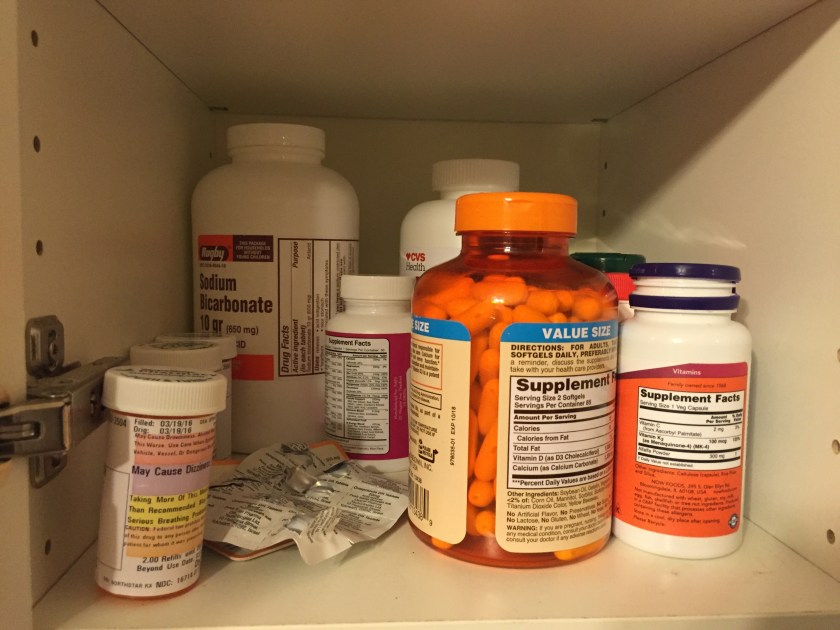
…I’m honestly losing track. Here’s the nonsense I deal with each morning (and these are only the morning, I didn’t get a picture of the nightly regimen):

IMG_3025

My morning medicine cabinet. Photo via J. W. Kain.

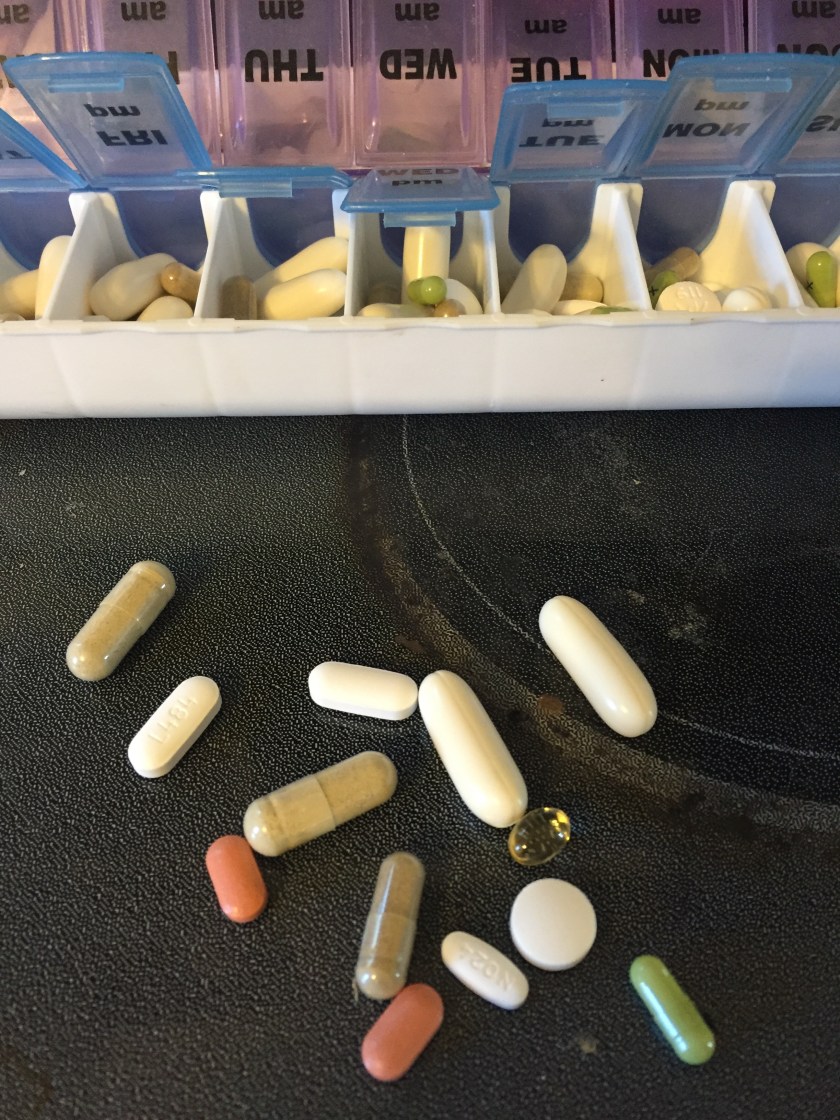
I can organize the hoard pretty easily using one of these sweet babies:

IMG_3031

My grandma and I are twins! Photo via J. W. Kain.

Those pill cases can be difficult when going somewhere overnight or for a few days. At this point I’m an expert at telling pills apart (and if I’m only 99 percent sure, I’ll Google it to be responsible), but it’s hard to say, “Okay, this group is for the morning, this group is for the evening… And let’s repeat this for the next few days I’m away from my medicine cabinet.” I do realize that the above pill organizer is labeled as A.M. and P.M., though I never use it that way. Those are all morning pills. Evening pills are kept upstairs.

So, I tried the Pill Suite.

NECESSARY DISCLAIMER: This is a sponsored post. I was given the Pill Suite through my membership in the Chronic Illness Bloggers‘ network in exchange for my thoughts and opinions regarding the device. All opinions are my own, and besides the gift of the Pill Suite system, I have not been influenced by the company in any way. 

Okay, now that’s out of the way. Let’s get back to the story. The Pill Suite aims to fill the vacuum that exists with any patient’s eternal question: “Which pills are these?” Stores do sell pill cases with AM/PM slots (see Exhibit A, above), but they’re large, bulky, and difficult to take on trips. If the compartment opens, pills fall everywhere. If airport officials want to see an official script, you have to produce it. (The Pill Suite doesn’t necessarily solve this problem, but I usually deal with that by taking pictures of the pill bottles on my phone for insurance purposes. So far I haven’t been questioned in that regard.)

My biggest complaint with the pill compartment I use every morning is that the slots fall open when it’s thrown in a suitcase. That leads to pills inside clothes, pills falling into dark crevices, and the scary possibility that I might be short some medication while I’m away from home. But I don’t want to have to duct-tape it shut!

How Does the Pill Suite Work?

It’s pretty smart, actually. Here’s the box:

Sorry for the glare, I’m not a professional photographer. Anyway, the idea is that you load the pills into the orange carousel, fill the plastic bags with said pills, seal the bags shut, and clearly label them for what they are: “Tuesday A.M. pills.” “Saturday P.M. pills.” “Grandma’s Horse Tranquilizer.” Stuff like that. The bags are even biodegradable. I have to admit that the green aspect of this machine was actually my first concern (how much waste would I be generating with those little plastic bags?), but it was immediately addressed.

How Easy is the Pill Suite to Use?

So easy. Here’s the process:

Again, I’m not a professional photographer. The above process took fewer than five minutes. You load the carousel’s designated pill slot, pour them into the baggie, seal it shut with the green apparatus, and then you’ve got a sealed, protected case for specific pills that has to be torn open. How cool is that?

Any Issues?

My only problem with the Pill Suite is that I take a lot of pills, so many that some got crushed when sticking them into the loading chamber. Filling all the baggies for daily use is tedious. However, there are plenty of times when I venture out of the house and use a tiny Altoid container as a pill box. I have no idea what’s what unless I Google it or know the pill by heart. I even used to put pills in my pockets if I knew I would only be gone a few hours — that’s not safe or hygienic. What if the pill fell through a hole in my pocket? What if some little animal snarfed it down? That’d be awful!

My Final Thoughts

The Pill Suite is great for trips, vacations, and changes in a normal schedule. Sometimes if my daily schedule is different, I’ll forget to take certain pills because my normal triggers aren’t activated (e.g., usually I’m in the kitchen by noon and remember to take a pill because of my surroundings). If I’m going out with friends, the pills will be safe in a labeled bag that has to be torn open. If I go away on vacation, I can fill daily baggies and separate the morning from the evening. Most importantly, I can also pack extras in case something terrible happens.

So yes, I do recommend the Pill Suite, for whatever my opinion is worth. It’s a great complement to any pill regimen, its plastic bags are biodegradable, and it’s safe. I think it’s definitely the next-safest way to keep pills out of the hands of kids and animals besides keeping the medication in its designated child-proof bottle, but who wants to carry bottles everywhere? It can also help if some medications mess up your short-term memory (“Did I already take these? I should take another one to be sure”). With this system, everything is clearly labeled. You can’t mess it up. You can’t overdose. And that’s worth a lot.

Pain News Network: Recovering from Spinal Surgery

Copy of ser-en-dip-it-y (n)Check out my latest column for the Pain News Network!

For those of you playing the home game (i.e. following my blog), I’ve been recuperating from a cervical discectomy and fusion of C4-C5. That was February 19. I’ve been recovering in an amazing fashion, much faster than my first fusion of C5-C6.

IMG_2899

At least I look better than this now. Most cyborg parts have been removed.

Just north of a month later, I also had thoracic injections at T-11 through L-1. I was far more scared of this procedure than the fusion — and I’ve had injections before, so it was nothing new. I knew exactly what was going to happen, but I didn’t know how my body would react. Why? Read on.

My Abbreviated Back Story (No Pun Intended)

My injuries have followed a strange road. When my mom’s car was stopped in traffic in 2004, we were rear-ended at 65 miles per hour. I was seventeen. I broke my spine in four places: T-11 through L-1, but also a facet joint that wasn’t found until a year later when it had calcified over a cluster of nerves. That’s why every movement in my midsection causes pain.

3812999850_e2bb2e0d89_b

You’ve caused me such trouble, you stupid, STUPID thoracic region. Photo credit: planetc1 via VisualHunt / CC BY-SA

Nine years later, my car was rear-ended again. This led to my cervical and lumbar issues, the two fusions, and a frightful double-injury to my thoracic region. We haven’t touched that area since before the second accident because every procedure known to man (shy of surgery) had already been attempted, and they generally don’t do surgery there unless you can’t walk. Plus, my neck was being very loud, so I had to deal with that before opening another can of worms. My doc decided to start at my head and work our way down from there.

My pain management doctor is incredible, amazing. Sympathetic, and smart as hell. Even so, in this current political climate and with the CDC’s asinine new guidelines, I have become afraid of the medical system in which I am firmly entrenched. Let’s discuss why.

The CDC Is Actively Harming Chronic Pain Patients

Normally I don’t write about the government. I don’t write about controversial issues because I don’t like arguing with people in the comments section. I didn’t write about the CDC releasing its opioid guidelines and how they glossed over chronic pain patients like we don’t exist. Before I get back to my thoracic injection story, here’s a blurb about why the CDC is so far off the mark that it hurts my heart.

One of my readers and I have been corresponding. After ages of complaining to doctors about intense, all-consuming pain, they discovered she had a tethered spinal cord — as in, her head is essentially falling off her neck, according to the MRI report. Not only that, but those MRIs she’d fought to get, that her pain management doctor had said were “unnecessary,” revealed a host of other problems that will likely all merit surgery at multiple levels of her spine. The level of pain in which she lives is unholy. And now she — and we — have to fight for pain medication? We know our bodies. We know what works. And sometimes we have no other options.

***UPDATE 4/24/16: Naturally, I messed up some of the details above. Here is a comment on this piece from the reader in question that clarifies the details. It’s in the comment section, but it makes more sense to put it up here as well.

I just saw the Ehlers-Danlos/tethered cord/craniocervical instability comments above and–as the bobblehead in question–figured I might delurk to clarify things.
A while back I fell down a narrow wooden staircase and developed a 24/7 occipital headache. After eleven months of begging every doctor I saw for help I still couldn’t get an MRI, but I figured it was the just curse of EDS and kept on.
Then, most unexpectedly, in the span of about three weeks I found myself under the care of three new specialists with all needed imaging completed, diagnoses with concurring second opinions made, and a tentative treatment plan in place. I was so excited that I sent J.W. this:
“…the MRIs I “didn’t need” have shown: sacrococcygeal subluxation, spina bifida occulta, tethered cord with conus ending near L4, severe DDD and herniation at L5-S1, vertebral hemangioma at T10, 35° segmental instability at C5-6, disc herniations with moderate-to-severe cord compression from C3-6, a ruptured alar ligament, and a probable fixed rotatory atlantoaxial subluxation. So apparently Doc is wrong, because my head IS halfway to falling off.”
The last line was in reference to J.W.’s earlier comment that “even if a f***ing fire cracker suddenly explodes and I whip my head to the side to see what the hullabaloo is all about, I will be okay. “I haven’t seen too many people have their head fall off,” Doc said. Comforting!”https://weartearandcare.com/2016/03/15/3-weeks-acdf-post-surgery-update/
So the link between my tethered cord and my bobblehead wasn’t physiological, but the result of a run-on list and a bad joke.
FWIW, I understand that releasing a tethered cord might produce additional craniocervical instability. In my neurosurgeon’s experience, however, detethering can also reduce tension through the cervical cord and provide symptom relief. For me, the tethered cord release was so urgent that even Dr. Big-Name-EDS-Neurosurgeon, who I believe usually deals with the head first, agreed that my tail was the place to begin.😉

To be fair, the “head falling off” quote was also from MY doctor telling me that my head wouldn’t separate from my body if a firecracker went off, but now we can eliminate all confusion. My darling Bobblehead, thank you for clarifying since I obviously misinterpreted your email. Your strength is inspiring, and your emails are always lovely to read. End of public service announcement.***

The CDC should not have the power to take away a method of pain control upon which so many people rely without providing appropriate alternatives. You can’t tell someone who’s had to rely on Percocet for 30 years, “Oh, well, we’re taking those away now. We’ll wean you off those, refer you to physical therapy, and really get you into meditation.”

Meditation is great. Mindfulness is great. Yoga is great. Those alternative medicines are great. I use them all. However, they are great as a complement to medication. Sometimes medication is all we can use in order to actually thrive in this world and not just sit in a chair all day, every day, watching television and not able to function. We don’t want to have to apply for SSDI. We want to live. We want to contribute to society.

We don’t take opioids to get high. We take opioids to feel normal.

Back to Spinal Injections

Anyway. Rant aside, the fact that I have been in two car accidents, have literally thousands of pages of medical history to back me up, and have countless doctors who can verify structural damage, I am still afraid of not being believed. Pain is subjective. People are prone to exaggeration. We have to fend for ourselves unless we find that one-in-a-million doctor who can help and is not afraid of prescribing legitimate medication.

Look at the California doctor who was recently convicted of murder for overprescribing painkillers for clients. She was actually reckless in her actions, but her conviction echoed throughout the medical community. Many other doctors will now prefer to be hands-off entirely, leaving patients in the lurch.

Thankfully, I have found the best pain management doctor at Beth Israel Deaconess Medical Center in Boston. He understands that I am not just one big injury; I am a cluster of injuries at three different levels of my spine that were brought on by two separate car accidents. It doesn’t seem like it’d be difficult to grasp, but so many doctors didn’t believe that the second car accident — much less drastic than the first — could cause so much pain.

It wasn’t just the accident; it was the compounding of pain. I was already in pain and had been for nine years. This second accident created more pain. It’s a simple equation that many pain clinics somehow failed to grasp. Thankfully, my spine surgeon and my pain management doctor got me. They understood. They cared.

IMG_2948 (1)

Plus, it’s kind of hard to fake evidence of a double-fusion. This photo belongs to J. W. Kain.

Which is why the thoracic injections were so horrifying. My brother was my designated ride, and after the procedure the nurses had to bring him back into the holding area because I was sobbing and on the brink of hysteria. (Naturally, in his haste he left my purse and coat in the waiting room, but he remembered all of his important stuff. Even in that state, I could see the humor of the situation.)

The pain of those thoracic injections — an area that hasn’t been touched for probably eight years — was so intense that I was literally screaming. These were diagnostic injections and a bit of steroid to see if the area was responsive after all this time. The doctor instructed the tech to give me a stress ball to squeeze and lots of tissues to drench. It took fewer than 10 minutes, but those 10 minutes were agony I have not felt before or since.

What if that had happened in front of a doctor I’d never met before? Somehow this was the same exact resident team who had done my lumbar injections a few months ago. Sometimes doctors switch up their accompanying residents, but nope — we recognized one another. They saw the stark before-and-after versions of me.

What if that travesty were my first procedure? The new doctor would’ve stopped everything. We might not even have gotten to injections, because he might’ve glanced over my voluminous medical chart and said, “There’s nothing new to try, and they already did so much. This might be the best it gets for you.” And so many of us are told this!

Nobody sits you down after an accident and says, “You’re going to have chronic pain for the rest of your life.” It’s not like a cancer diagnosis when you only have so long to live. It’s always, “Well, at least you didn’t die!” We all think that we deserve to feel like we did before. We put our lives on hold because we think “I am going to get back to what I was. I’ll do the things I dreamed of doing… when I feel better.”

When I feel better. It’s always that thought in the back of our minds.

I finally realized that there might come a threshold where this is the best I get, and it won’t be close to what I used to be. Sometimes it’s not physically possible to be 100 percent again. If I can live a life that doesn’t just feel like “functioning,” like an automaton whirring my way through the day until I power down at night, then I will have succeeded. If I can do my job and contribute to society, I will have won. Then I think of all the patients who don’t have doctors they trust, who aren’t listened to, who aren’t taken seriously, and who aren’t believed.

In this new world of medical uncertainty, chronic illness patients need to form networks and advocacy groups. We need to share experiences with doctors. Was he understanding? Was she ready to help? Is their clinic’s position “deep breathing” instead of proper medication?

We need to participate, no matter how terrible we feel. In any capacity, in any way we can, we need to be our own advocates.

3 Weeks ACDF Post-Surgery Update

Copy of ser-en-dip-it-y (n) (1)

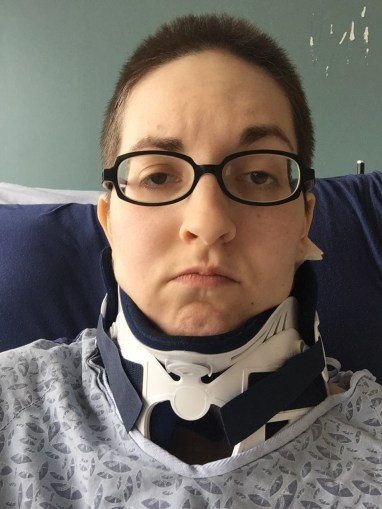
I had my first follow-up on Friday with my surgeon. Up until that point I’d been in my pajamas with a hard neck collar, buzzed hair, thick black-rimmed glasses, and obviously no makeup. There wasn’t anything close to “hot” in “hot mess” here. But hey, buzzed hair = barely shampooing = don’t knock it ’til you try it, because trying to shampoo your hair after neck surgery is a wench.

IMG_2899

This was taken mid-February. We’ve come quite a long way in a short amount of time, folks. Now the hair is basically a pixie cut instead of the Furiosa.

My latest foray into the outside world before seeing my surgeon for the all-clear? Chasing my damn cat, Fattie, who decided that the cold muddy day of the week was the perfect time to sneak past me out the front door while I talked to a woman across the street. She made to leap from the front steps straight onto the muddy ground and then — after shrieking at me for grabbing her tail — gave me a furious look like the mud was somehow my fault.

IMG_2949

You are TR-8R.

“Excuse me a moment,” I said before scrambling after the cat, socks in the mud while my poor neighbor just stared at me (thanks for the help!). This simple trek around the house literally exhausted me to the point that afterward I had to shower. (One lovely side effect of all the narcotics and withdrawing from them? SWEATING. OH MY GOD. THE SWEATING. I’ll fold laundry and start sweating. It’s absurd.)

Anyway, my house has a giant fence around it that Fattie is either too scared to scale or too stupid to realize that it’s something over which she can jump. She has a set route that takes her around the house and around again in circles, forever, until you catch her. I got her maybe 3/4 of the way through by bribing her and her traitorous, muddy paws with food.

Anyway, I had an original point. My first surgical follow-up. Yes. My mother came to take me to the appointment, and she kept saying how much better I look. I even sound different, apparently. I sound better than I did before the second car accident. She’s not so scared to approach certain topics, like “But you look so good! You must be feeling great!” We even managed to make our way through Nordstrom to pick out dresses for my cousin’s upcoming wedding. I’d warned Mom that I start to sundown around 2 or 3 pm. My appointment was at 2. We were informed, upon arrival, that an emergency at the hospital had caused my doc’s previous day’s patients to be shoved to the next day, meaning it was another 1.5 hours before I saw anyone of the medical variety. Got my X-Rays taken, had my questions written down — I was ready to go. I was actually feeling relatively okay, energy-level-wise. I mean, I’m on Percocet, but still. Weaning off those now. Hence the lovely sweating.

So check out this double-fusion, boys and girls!

IMG_2948 (1)

This is J. W. Kain’s C4-C6 fusion. Don’t none of y’all pretend it’s yours! That’s MINE!

So check out the right picture. The dark vertical tube-ish area next to the plate and screws is my esophagus. See that pocket-looking thing? I was super concerned that it was like, you know, a real pocket. Things have been getting stuck. Remember the mucus? (Oh yes. Yes, you do. That post is a scar upon your mind that doesn’t go away.) That hasn’t gotten much better. I’m still on a mostly-liquid diet. I’ve lost 15 pounds. Doc said that it’s a ton of A.) scar tissue from the previous surgery and B.) inflammation from this surgery. So yes, in effect it’s forming a pocket that’s preventing me from eating food that hasn’t been chewed within an inch of its life. I asked him how long it should be before that goes away; he said maybe six weeks. Given my weird esophagus, I am skeptical.

Side note: Here’s all you need to know about my weird esophagus and how food and I have a weird relationship: I am “allergic” to wheat/gluten, dairy, fish, and peanuts because of an autoimmune disease called eosinophilic esophagitis. This means my body thinks certain foods are the enemy and go into a histamine-sort of response, my throat gets super irritated, and I toss my cookies, or, as they probably say in France, tercer tes biscuits. Google translate’s saying mélanger vos cookies. Not sure. There ya go. 

Doc cleared me of the hard cervical collar and said the soft one isn’t even a necessary transition point, which it definitely was last time FOR MONTHS. We just skipped that step this time! I can wear the collar if I feel I need to, but even if a f***ing fire cracker suddenly explodes and I whip my head to the side to see what the hullabaloo is all about, I will be okay. “I haven’t seen too many people have their head fall off,” Doc said. Comforting!

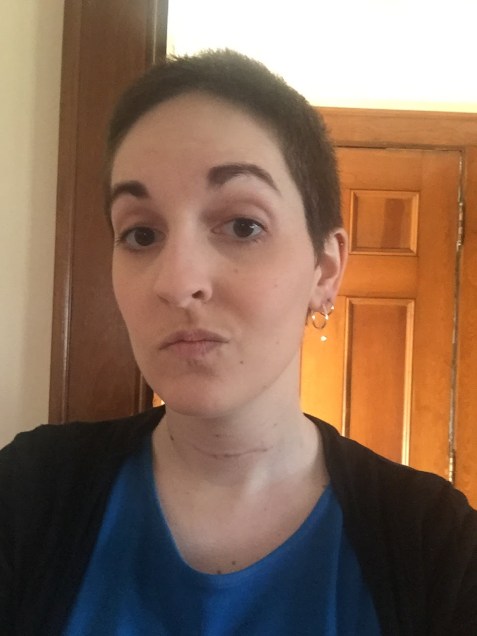
I can drive. I’m able to start physical therapy. I can basically do whatever my body allows me to do. He even took the stitches out. Right now it’s a bit gruesome, and it’s joined the previous scar to look like one continuous murder attempt that will eventually soften into the natural lines of my neck. My brother said it looks pretty brutal, like I’ve survived assassination. Like I fought off a scimitar. I was checking it out in the mirror and realized I kind of like it. It tells a story. It says I was stronger than whatever happened there. I didn’t want to get too close to it with the camera because it is still pretty raw. But here you go:

IMG_2951

In all seriousness, it’s not too bad. And yes. That’s me. Hello. Makeup and non-pajamas for the first time in almost a month.

My energy levels are up. I’m not napping hardly at all, and while I am only taking Valium at night, I’m on halves of Percocet every five hours or so. I’m still waking up at 5 in the morning when the meds have definitely worn off and I need another dose. Doc wants me to move down to Tramadol and then eventually to Tylenol. I can make that happen. My friends came over this past weekend; I was able to hang out with them sans cervical collar and sit through both VHS versions of Star Wars: A New Hope and The Empire Strikes Back (pre-special edition, so they hadn’t been destroyed by George Lucas yet; we got them for a dollar each at the library book sale). I am kind of able to do simple yoga if it’s from the shoulders down. I am cleared, the stitches are out, and life is looking great! I am even able to finally start to get back to work (as I feel up to it, my surgeon stressed).

Future posts? Back to work! I’ll be discussing the transition to working from home, tax implications for freelancers (oh yes, you heard that right, it’s going to be FUN TIMES ALL AROUND), and how to make the jump from the working world as safely as possible. In the meantime? I’m healing. I’m coloring. I’m meditating. I’m exhausted. I’m feeling happy. Things are great, and I hope today makes you as happy as it’s making me.


ACT BY NOON TODAY 3/10 to Save Schatz Amendment 3435 to Address Chronic Pain & Opioid Abuse

Source: ACT BY NOON TODAY 3/10 to Save Schatz Amendment 3435 to Address Chronic Pain & Opioid Abuse

Anterior Cervical Discectomy & Fusion… and Phlegmy, Phlegmy Mucus

Copy of ser-en-dip-it-y (n) (2)

That’s an ominous title, isn’t it? BUCKLE UP, BUCKAROOS!

FIRST OFF: I HAD SPINAL SURGERY, AND IT WAS TOTALLY WORTH IT.

My first surgery wasn’t quite the success for which I’d hoped. I tried not to hope for this one, because I didn’t want to get my feelings hurt. Well, boys and girls, this one worked. It’s like the first time they dug around in my neck, they only pulled out half a rotting tooth before stitching me back up. The second surgery removed the rest of that festering, pulsating monstrosity and cleaned it out entirely. So, was it worth it? Heck yes. 

HEY HEY, I HAD SURGERY
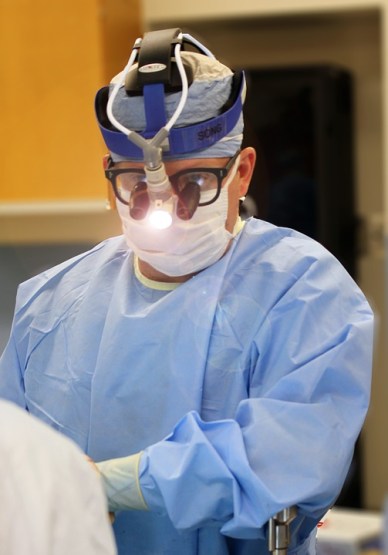
surgeon-1049534_960_720

Ms. Kain, welcome back. Your frequent flier membership card has been updated, and you’ve won a free blender for your customer loyalty!

I am now a bit more than one week post-anterior cervical discectomy and fusion. I had the same procedure as I did two years ago (ACDF, levels C4-C5 as opposed to the earlier C5-C6). It was the same hospital, even the same surgeon, and yet so many things were different. Round I was March 27, 2014. I remember four things vividly:

  • the feeling of funny juice speeding through my body right before they wheeled me into the operating room;
  • mouthing “I love you” to my husband as they wheeled me past him;
  • the difficulty of waking up from anesthesia, the nurse pressing a wet sponge to my cracked lips, my eyelids at different levels as I kept trying and trying to swim up from the clinging darkness; and
  • one of the technicians saying, “She’s still wearing a thong, is that okay?” right before I passed out. When they tell you to get into the hospital gown and “take everything off,” I kind of just… didn’t. Seventy-eight percent of my underwear would make a stripper’s mother cry. The odds were not in my favor.

This time around, they beat me to it with delightful “one-size-fits-all” gray granny panties to wear with my hair net, bland gown, and traction socks.

THE FURIOSA

I viewed my head decoration options as being one of two choices: 1) I could not get a haircut before surgery, let it grow out awkwardly for three months (you know… that stage), and look like a 12-year-old Dutch boy. Instead, I opted for 2) buzzing my hair.

monk-977208_960_720

It turned out to be just that length, actually.

It was that or a mohawk, but I’ve always had a hankering to look like Imperator Furiosa. It gave me an innate feeling of kick-ass. My intensely awesome hair dresser, Lorilee, always seems to schedule a drastic hair change at the same time as I do. She’d shaved her head as well. After she let me see what a mohawk would look like, I chose the buzz. I was the Bride, I was Hit Girl, I was Storm at whatever point in the comic series it was when she shaved her head. I could destroy anything in my path. By the time I’m due for a haircut again, it’ll have grown into a lovely pixie. Meanwhile, I won’t have to shampoo/dry/style it and hurt my neck. Everybody wins! I went into surgery fully prepared. I was scared, yes, because we’d been here before. The last surgery already made promises it’d failed to keep. But I was going to go in fully prepared, despite that first disappointment. My haircut would accompany me through the valley of C4-C5.

NOT EATING FOR 22 HOURS IS THE WORST

Husband stayed with me right up until the doors closed. I was already grumpy because I hadn’t eaten since midnight for a 1:30 pm surgery (Nurse: “If the person in front of you cancels, you still need to be prepared”… like that would literally EVER HAPPEN), and then it got pushed to 4 pm. Strangely, I wasn’t hungry the entire day. I paced the waiting room, tried to read, stared at the small aquarium, stretched out on the floor (“Oh, God, no, honey, don’t do that! Think of where you are!” a passing nurse called. I got up immediately). When they finally called me back into the holding pen, I got a television with access to four Spanish soap operas, three religious channels, and Jerry Springer. Naturally it was an episode about twerking’s predecessor, “the booty shake-off.” One of the girls was so bad at twerking that she decided to fail all over the stripper pole instead. Meanwhile, St. Elizabeth‘s is a decidedly Catholic hospital that my insurance network prefers.

nun-32425_960_720

This image is needed after the link to the booty shake-off.

Side Note: I love St. Elizabeth’s. The doctors are extremely nice, and the staff is very skilled. One of the nursing staff even just held my hand before going in for surgery. And she held on tightly, for a long time, and made me feel welcomed and calm. 

Dr. Glazer (best surgeon ever) soon arrived and drew a line on my throat — higher up than last time, on the other side so as to lessen esophageal injury. Then Husband kissed me and they wheeled me into the OR, where a gas mask was put over my nose and mouth. I had been holding a conversation with the anesthesiologist, and then I woke up to a blurry man leaning over me with what looked was either a fu manchu or a very organized series of caterpillars on his face. I could feel the cage of the hard neck brace holding my head still. Toki Wartooth and I started talking — my voice a raspy ruin from the surgeons shoving my esophagus aside to attack C4-C5 and add it to my established fusion. Quickly thereafter my husband was there, sliding my glasses onto my face and bringing the world back into clarity. Husband had even smuggled in Grumpy Cat, who’d descended from the blurry ether two years prior after my first surgery. Toki the fu-manchued nurse kept pushing Dilaudid into my IV, but the pain wasn’t dampened until he gave me some Valium to relax my spasming muscles. They hold you in a strange position for cervical surgery that actually hurts the shoulders more than the neck. Even now, more than a week later, my shoulders are smarting.

SLEEP MEANS THE OPPOSITE ONLY WITH THE MAFIA, IN HOSPITALS, AND AT SLEEP-OVERS

I spent the night this time. After the last surgery I left as soon as humanly possible; the sterile air, the smell of the soap, the inflatable leg sleeves to keep blood circulating — it drove me bonkers. This time I was more than content to sleep, and sleep, and sleep. Of course, I was woken up every two hours. They tried to get me to use a bed pan — helllllll to the no. My body assumed the position, but my muscles refused to even knowledge that the situation existed. They let me shuffle to the bathroom after that, clinging to my IV pole. Upon my slow return, more needle sticks, more blood draws, more drugs given. One nurse even gave me a sponge bath; rather, she provided all the implements for me to give myself a sponge bath. Navigating a sponge while on doped on Percocet and attached to an IV, that was fun!

Dr. Glazer swung by to discharge me the following morning, confirming that the disc was actually a very bad disc, something that hadn’t made itself known during the MRI besides its positioning. See, this made me feel great, because I wasn’t sure if I was preempting this surgery, if it really was that bad, if I could’ve waited just a bit longer, etc.
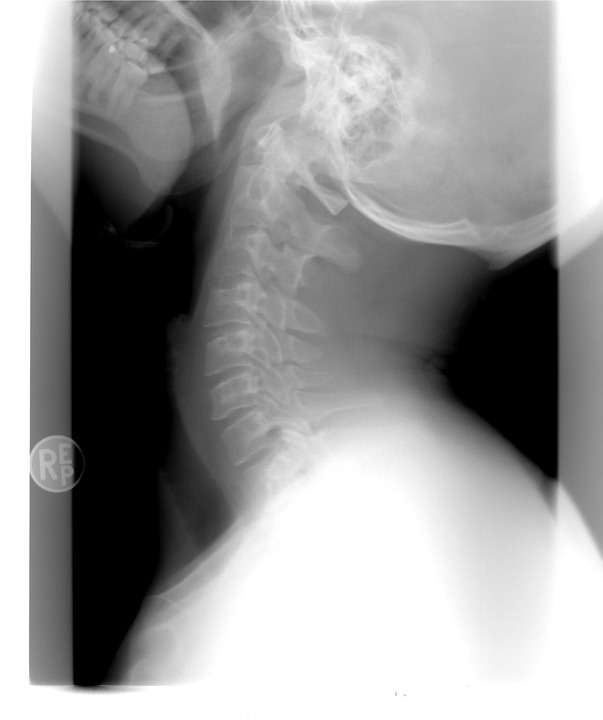
xray-1129436_960_720

Bad disc! BAD DISC!

My sleeping schedule has been strange since that night. I was up that night after surgery from 3 am to 4 am, trolling imgur.com and texting whichever friends I thought might be awake. None of them was; I was dismayed. The one time I was up when they would be, and they weren’t up. Now I’m sleeping 12 hours a night, getting up for a few hours, sleeping another three hours, and then still climbing into bed at a normal time with Husband. And I’m still relegated to clear/flu foods. It’s easier to get around on my own this time, though. I’m wearing the hard collar less frequently. I’m even taking short walks already. My amazing mama stayed with me two days, and then my fantastic brother stayed over so that Husband could go to work. They took care of me, which was fabulous. That first weekend was just with Husband, though. We had such a nice adventure that, afterward, when my mother showed up to assume the post of caregiver, Husband admitted how relieved he was to have an adult in the house who was more of an adult than either of us.

MALICIOUS MUCUS MONSTER

So let’s discuss something that is all over Google as an unanswered question when you search for some variation of “Wife post-acdf phlegm mucus throat vomit.” I was put on a clear diet after the surgery, so Jello, broth, popsicles, etc. It’s not a lot of variety. And it made me sad. This is coming from someone who’d eaten a peanut butter sandwich every day at school lunch for 12 years. By choice.

I got home, and I kept eating flavored water, frozen water, hot water, and regular water. My second night home I decided to try yogurt. My discharge instructions hadn’t said to keep up the clear diet, and yogurt’s soft; I also hadn’t had any restrictions after the first surgery. I gave it a whirl and subsequently woke up at 2 am, my throat coated, unable to swallow meds, and then vomiting a semi-solid green flag of mucus. It hurt to breathe, and I just. Kept. Hurling. Inhale — BLARGH –Inhale — BLARGH — Inhale — BLARGH. I honestly thought I’d somehow puke through my stitches.

star-wars-1105582_960_720

I basically gagged up Slimer from Ghost Busters.

“I’m taking you to the ER,” Husband said as he stood in the bathroom door. I could only nod in response before heaving up what felt like a number of my internal organs. Vomiting in front of my husband is one of the items of my list of “Things I Never Want My Husband To See.” Other items on this list that he will never see if I have anything to say about it: me pooping in the bathroom — while the door unexpectedly opens as he’s walking by. Me going through childbirth. Me waxing my eyebrows and upper lip. You get the idea.

THE LOCAL HOSPITAL

On the plus side, the local ER at 2 am on a non-holiday weekend (besides my birthday, true story) is very quiet. There was just one sobbing woman down the hall. Otherwise I was in and out in an hour. Apparently mucus buildup is a very real thing after neck surgeries because of the endotracheal tube, which somehow did not bother me so much the first time around and did not seem to be addressed in my discharge instructions.

They pumped me full of an anti-nausea, Dilaudid, and Benedryl as well as fluids to replace my body’s whole volume of water. Soon I felt as swollen as BayMax from Big Hero 6. After Husband carried my floppy body home and poured me into bed, he stayed up all night making sure that I continued to breathe. Many nights since then, Husband’s slept in the guest room because while I don’t “snore,” I make kind of a snorkeling sound in the back of my throat and become a mouth-breather. Bed to myself!

CURRENT MEDICAL CLIMATE POST-SURGERY

I was very curious as to how the ER nurses would treat me given the current political pharmaceutical situation in the United States. I’d thrown up two of my precious Percocet, and I’d signed a pain contract stating that those pills could not be replaced for any reason, which — technically speaking — includes everything up from vomiting to post-apocalyptic global breakdown. When I explained this to the nurse and said that it also hurt too much to swallow the pills, she said, “Don’t worry, we’ll give you… What were you taking? Morphine? Dilaudid?”

Um. What?

I’ve been reading stories for months stating how chronic pain patients go to the ER and are turned away like drug addicts. I know I was wearing a cervical collar and had a bandage and was vomiting profusely into a trash bag and they took a pee test and saw I wasn’t high, but still. I know they have training to see who’s real and who’s a drug seeker, but I just still found myself surprised at how readily they helped me. I even offered to show them my prescription bottle and let them account for the pills, but they waved it off. “I can see you just had surgery,” one said. They were pleasant, quick, smart, courteous, and sympathetic. They rehydrated me, gave me a blanket, and got me all of my meds before sending me home, two minutes away.

Also, when Husband and I drove home, we saw three teenagers walking away from town at 3:50ish am. What are these young kids doing these days!? Good Lord. Those are sleepin’ numbers.

universe-1044107_960_720

WHO ARE YOU? YOU WEIRD, SLEEPLESS PEOPLE?!

PRESENT MOMENTS

I am starting to sleep fewer than, you know, 15 hours a day. Already trying to swap Percocet for Tramadol. It’s definitely healing faster than the last round, but it will still take time. When my brother was here he suggested going to the mall — fewer than five minutes from my house — getting a specific pair of shoes, and leaving immediately. This was just to get me outside. I readily agreed, having napped for three hours. Halfway through our jaunt, I found myself sweaty, pale, and winding down. I’d been up for 15 minutes.

The basic premise of my day revolves around my recliner, the television, and my laptop. Or I’m napping. It’ll be that way for a little while longer, but soon I’ll be walking farther and farther, longer and longer. I’ll get back to exercising. I’ll get back to fixing myself.
 

Guest Post: Bio-Integrative Therapy: Modern Medicine Has a Health Problem

Copy of ser-en-dip-it-y (n) (3)

Full disclosure, readers: This guest post was written by my father, Dr. Jay Kain. He’s starting a new business venture that combines motion capture technology with his proprietary work, Bio-Integrative Therapy, and I am hellishly proud of him. The therapy (speaking from experience here) is very gentle, hands-on manual therapy that works to promote structural harmony within the body. The motion capture work quantifies the immediate results the therapy provides (e.g., you have a terrible golf swing, you get some treatment, and then the mo-cap immediately shows results in increased range of motion. How’s that for fast healing?). He’s finally getting on board with technology, so here’s his foray into the blogging world! He is also on Twitter as @bio_integrative.

Modern medicine has a health problem.

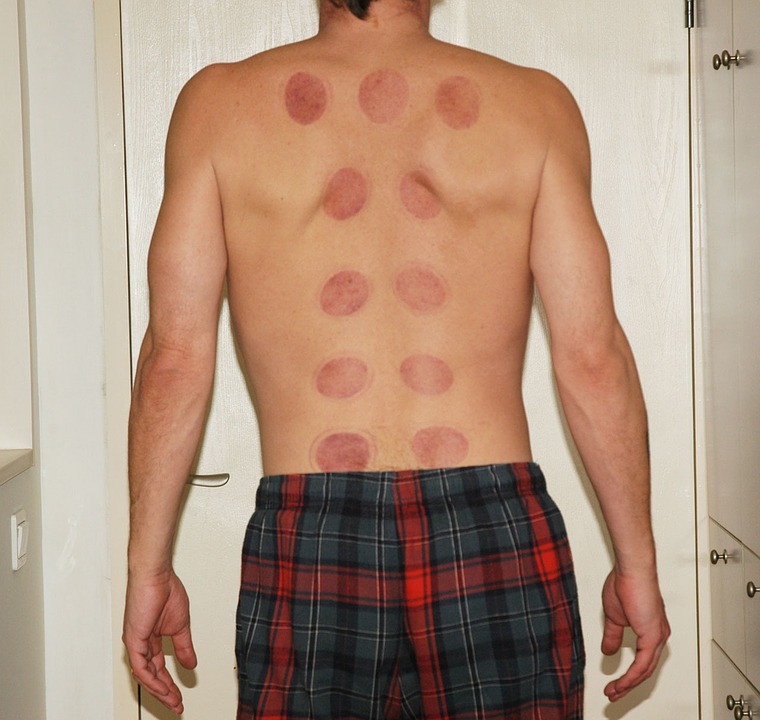
It sounds ridiculous, doesn’t it? Western medicine is more advanced than ever before. More importantly, it now defers to Eastern medicine when necessary, like pain management doctors recommending yoga, meditation, acupuncture, and the like. Physical therapists use cupping techniques that were created in China centuries ago.

acupuncture-13876_960_720

Not everyone is a fan. (Via Pixabay.)

Cardiologists team up with dietitians so that patients can learn how food itself is medicine. After decades of not letting these methods sit at the cool kids’ lunch table, modern medicine has finally started including holistic practices because it sees the inherent value.

Regardless, there is still a fundamental issue — and everyone who has been a patient in today’s medical system knows what it is.

Say you’re in the garden yanking out weeds. Then it happens: a pop in your lower back that flares along your nerve endings like boiling oil. The weeding comes to an abrupt end, and you spend the rest of the weekend writhing in bed. You go to the doctor on Monday. He diagnoses an acute strain that is putting pressure on your sciatic nerve. He prescribes some pain medication and a muscle relaxer, and you limp along on your way.

trap-33819_960_720

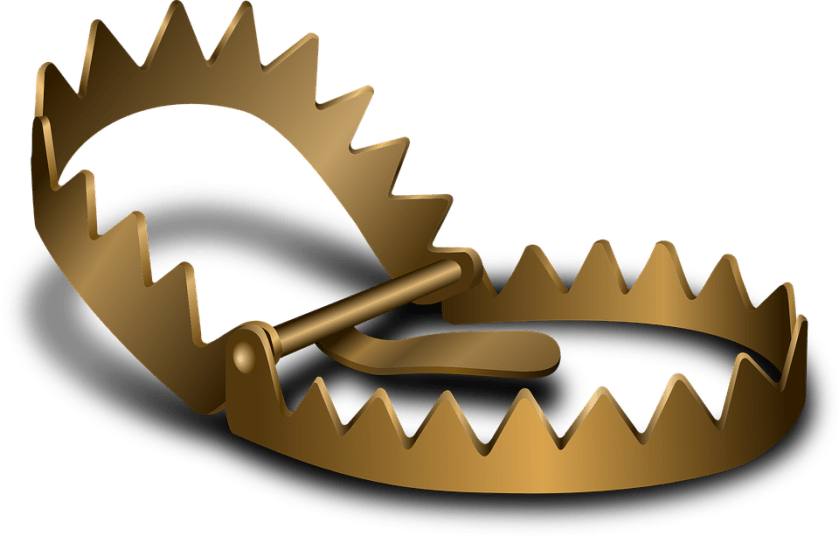
Most of the time, your leg feels like it’s trapped in this. (Via Pixabay)

… Except the pain doesn’t get better. You bounce from doctor to doctor, specialist to specialist, trying to figure out why your back is still throbbing and your leg is still on fire. Doctors give you medicine, stretches, inject you with steroids, send you to physical therapy, give you a TENS unit, and on and on… for years. You resign yourself to the fact that this pain is forever.

Question: What is the fundamental problem with the above scenario?

Answer: It is reactionary.

In Eastern medicine, doctors were paid only when the patient was well; if that patient got sick, then that doctor obviously wasn’t doing his job. Western medicine, on the other hand, deals with disease; it waits until the patient is sick or injured, and treats based on the problem at hand. They do this by using the “cut, burn, and poison” approach. Pills are the first line of treatment instead of putting the body back in balance.

medicine-848503_960_720

Modern medicine is not as concerned with holistic care as it is with making sure you don’t die. (Via Pixabay.)

Granted, for things like OB/GYN, trauma, open wounds, and emergency medicine, Western medicine is the best. I don’t want supplements like Traumeel when I’m bleeding on a gurney. For other illnesses and conditions, however — the chronic conditions, the long-standing problems — Western medicine treats the symptoms and not the cause.

My work — Bio-Integrative Therapy — treats the cause.

There are so many health care practitioners out there promising to heal you, to get rid of your pain, to make you the person you used to be. I’m not promising that. What I can promise is that with my work, you will feel better. We will treat the root cause of your physical problems. What good is it when you fix your leg again and again when the problem is actually in your low back?

If I met with the man who strained himself weeding the garden, I’d do a scan of his body to see where the true problem is hiding. It might be a bulging disc in the lumbar region; it might be from poor posture; it could even be an accumulation of mechanical stress that finally snapped. Whatever it is, I am able to dig under layers and layers of false alarms, pain, and scar tissue to find the true issue.

How do I do this?

My methods are the culmination of decades of work and research, and it pulls in wisdom from several different methodologies. In practice, it is done with my hands and my intention. The patient is only required to lie on a table. I do the rest.

The best part? You can even do it yourself.

This blog is my way of introducing this work to the world. I want everyone to know about it. I want everyone to be able to do it.

And why should you listen to me?

My name is Dr. Jay Kain, and I am the owner of Jay Kain Holistic HealthCare in Great Barrington, Massachusetts.

jay

Jay Kain, PhD

I created BITEC (Bio-Integrative Therapy for Every Competitor) with my colleague, Cindy Powers. Together we are using motion capture software to quantify the results of Bio-Integrative Therapy. BITEC is focused on sports, but the actual technique is able to be used by literally everyone.

Print

I have 35 years of clinical experience. My journey in the healthcare field started out in a traditional manner: I treated symptoms as an athletic trainer. If somebody came in with a sprained ankle, I’d follow the RICE theory that trainers still use today: Rest, Ice, Compression, and Elevation. Get the person functional and get him back to his sport.

Then I started physical therapy and hands-on manual therapy, because I saw that they caused faster, more effective results. This led the way to integrative manual therapy, and from there I began creating my own treatment. My approach has always been to find a better way to help the body balance itself. Remember, the body is the best doctor there is. If you can help it facilitate its own healing, then you’re golden.

hand-351277_960_720

This — and every other pair of human hands in the world — is by far the best instrument for healing the human body that I have ever found. And I’ve been practicing for more than 30 years. (Via Pixabay)

I use my hands and experience to coax the body into a better balance. Chiropractors manipulate the spine to gain alignment; I gain alignment in all areas of the body. Connective tissue makes up the ligaments, muscles, the infrastructure of blood vessels, nerves, and bone. I am able to manipulate this connective tissue and let the patient’s body regain alignment. When the body’s balanced, there is no pain or disease.

The techniques I’ve developed let me to facilitate changes in the gentlest way. There’s no snapping or popping or traction or device. I just use my hands. That’s it. Nothing fancy. I’ve taught this work to laypeople as well as professionals. Literally everyone can do it. To be honest, laypeople are sometimes even better at it because they don’t have preconceived notions. It takes a professional background to understand the integration of the bodily systems, but anyone can learn the techniques. And guess what? It works faster than any other therapy I’ve seen or tried.

YOU CAN FEEL BETTER. 

I can teach you this remarkably simple set of techniques and how it can be applied to any problem in the body. Headache? Migraines? Back ache? Leg sprain? Fibromyalgia? Lupus? Pain from Lyme Disease? It’s all covered. This blog will soon have YouTube videos, links to course work from classes I’ve taught, diagrams, charts, and everything else you need to learn how to become a Bio-Integrative Therapist. There will be video classes that can earn you certification credit. I will make podcasts. I will have live classes all over the country. Most importantly, I will be — and I am — accessible for anybody who needs help.

Healing the body is a business that has become too complicated. There are too many companies with conflicts of interests and too many doctors beholden to insurance requirements. My work will let you feel better — on your own terms.

Pain News Network: Dressing for Comfort and Success

Copy of ser-en-dip-it-y (n) (4)

Check out my latest column for the Pain News Network!
Comedian Patton Oswalt once apologized for all the times he made fun of sweatpants.

“I thought the pinnacle of mankind would be Mars colony or teleportation. Nope! Sweatpants! That was it. Sweatpants!” he said. “We started with fire and the wheel and writing, agriculture, penicillin, sweatpants. Everything else, we’re just on the downward slope. We did it. We’re all done.”

Oswalt went on to say how one never puts sweatpants on after showering; they’re always worn over “un-deodorized flesh,” with which I disagree. Why? Because I just took a shower and then put my sweatpants back on. (That’s not the point of this post.)

If you are one of the approximately 60 million people in the world with chronic pain, you know that regular clothes can just hurt. It becomes a burden to wear something as regular as jeans. We operate by feel alone.

What is comfortable? What doesn’t compound our pain? What feels good against our tortured skin?

Sweatpants!

This obviously was a problem for me when I was in the working force. An attorney cannot wear sweatpants to court or when meeting with clients……. or can she?

Behold:

That’s me. This outfit was actually remarkably comfortable. Want to know why? Those are Clarks Kearns Blush boots (literally one of three pairs of shoes I can wear that provide support for my back) and Betabrand’s Dress Pant Yoga Pants (boot cut style).

They work better than, say, black sweatpants or regular yoga pants, because they have fake buttons and pockets. They look like real pants. They are deceptive. It’s a genius idea that fools both court officials and other attorneys into thinking that I am appropriately dressed.

They’re a bit pricey, but they are totally worth it. I own three pairs because regular pants just hurt when my sciatica runs down my legs or my low back starts firing off. I want to be as comfortable as possible, and even well-worn jeans cannot make that happen.

Bonus point for the Dress Pant Yoga Pants: They are one of very few styles that can hide the Quell device.

The jacket is also the same kind of sweatshirt-ish material and was found at H&M.

Betabrand makes a number of products designed for office comfort like the Work-It Skort and the Travel Dress Suit, as well as a zip-up suit “onesie” for men. Not quite sure what I think about that one, but you have to admit it looks pretty convincing.

These can be lifesavers for people who choose clothes by comfort level instead of presentability, as they allow us to achieve both objectives instead of them being mutually exclusive.

The bottom line is that chronic pain patients no longer have to make concessions when it comes to fashion. We don’t need to go outside looking like hobos just because we feel terrible.

It’s common knowledge that by looking good, we can fool ourselves into feeling good. It’s difficult to face the world when you are only armed with sweatpants and no makeup. That’s why I try to wear even just base makeup on a daily basis; you never know who might knock on the door or who you might run into while outside the house, but more importantly, I like feeling pretty.

Sometimes it’s hard to get the motivation even to put on the Betabrand pants, because I associate those with work now. However, I know that when I wear them, I look like I belong in the professional world… and that feels great.

The Quell Pain Relief Device: 8 Months Later

Copy of ser-en-dip-it-y (n) (5)

Hi, everyone. It’s been quite some time since I’ve shouted into the electronic void. I had such grand plans, too. At the end of 2015 I left my full-time job as an associate attorney. My bosses did so much for me, but the way our office was set up, having me work part-time just wasn’t possible. The month of December was my slow transition to working from home. I still have my freelance editing work, but primarily I am home. In my sweatpants. With my cat.

IMG_2551

“The winter is harsh this year.”

I figured I would use this time to write a ton of blog posts, start my new website (to be formally announced at a later date), do yoga four times a day, walk an hour every day, finally go to the gym, hang out with my cat, wake up at 5 a.m. during the work week, do some personal writing for the first time in years, etc. I had grand, unrealistic plans. At the very least I still plan to discuss transitioning to working from home, but that’s not the point of this post.

meditation-972472_960_720

This was my plan. It has not yet materialized.

So what kept me from my grand plans? All of you know the answer: indescribable pain.

I’d anticipated that upon returning home, my pain would get better. I had a doctor’s appointment near my old office about two weeks into January, so I swung by to say hello. My former coworkers all asked the same question: “Are you feeling better?”

I was surprised to realize that the answer was “No.” I wasn’t feeling better. If anything, I was feeling worse. I panicked and talked it over with my therapist. Was my job just a distraction and now I could focus on my pain all the time? Was the pain actually getting worse? Was I just whining endlessly? Was my catastrophic thinking compounding my agony? Was I weak and subconsciously wanted to take my meds so I could float all day, forever?

question-mark-1019759_960_720

So many questions!

It took almost three weeks of internal reflection to realize what the difference was. When I figured it out, I felt really stupid. So stupid. Like, really stupid. I’m sure there’s more to it than this (unwinding for the first time in years, my body comprehending the fact I don’t have to sit at a desk 10 hours a day, and more), but the fundamental difference between my time working a full-time job and my time at home was that I had forgotten to wear my Quell device most days.

813_1

Via QuellRelief.com.

For those of you who don’t know, the Quell works by placing sticky electrodes on your upper calf so that electrical stimulation activates the wearer’s endogenous opioid system. This creates a natural feeling of pain relief in the user. In order to let my skin rest, it had become second nature to take the Quell off when I was in my house. If I don’t do that, my calves become irritated and red. I guess after leaving the office, my routine was so interrupted that I forgot the Quell entirely except when I ventured outside of the house on errands. Once I realized this a few days ago and wore it again, the pain started to recede. Now it’s manageable once more.

Bottom line: I am a forgetful idiot.

idiots-62613_960_720

I searched for “idiot” and got sheep. Now you will get sheep.

This illustrates the power of the Quell to me, though. (Not the sheep. The sheep don’t illustrate much at all.) I saw firsthand what happened when I forgot to wear it. The pain gained force like a hurricane, overwhelming me entirely. My hard medications, which I normally save for the evening, became a lifeline around noon. I blamed it on my unfamiliar new life, the fact that I was finally “relaxing,” and that I had fewer distractions. Nope! I’m just an idiot.

I have been scheduled for another cervical fusion and discectomy next month. Until I recover from that, my schedule will be scaled way back. Linda, my pain therapist, suggested that I focus on four things at most. I wrote a list of my plans yesterday. It was about a page long.

Here are my choices: freelance work capped at about three hours a day, yoga every day if I can, online marketing/copy writing lessons, and puttering around the house. “Puttering” includes organizing, marking things for donation, and cleaning what I can. It actually helps to clear my head. Remarkably, my days feel so much shorter even though I have more time. Cleaning out my house is calming. I like the idea of essentialism. That’s a post for another day.

I’m excited for new opportunities. I’m excited to keep reshaping my life. I’m also excited to take you on this journey with me.

Pain News Network: The ActiPatch

Copy of ser-en-dip-it-y (n) (6)

Here’s my latest column for the Pain News Network!

Loyal readers, I have returned.

It’s been a tumultuous month of bad days and flares, so while I was absent from my writing duties, I was trying out a hodgepodge of products designed to offer pain relief.

Naturally, none of them worked. Let’s discuss.

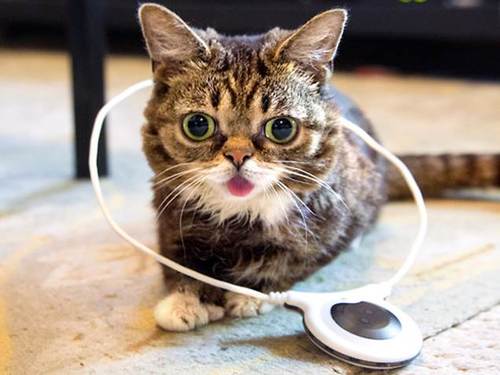
A while ago it was suggested that I try the ActiPatch. I was originally introduced to this new form of pain product by Lil’ Bub, the celebrity cat.

I should probably explain that.

Lil’ Bub, full name Lillian Bubbles, is a perma-kitten, meaning that she will retain her kitten-like characteristics for her entire lifespan. She also has an extreme case of dwarfism and a rare bone condition called osteopetrosis (the only cat in recorded history to have it), which causes her bones to become incredibly dense as she grows older. This causes pain and difficulty when she tries to go from Point A to Point B.

download

Image courtesy of lilbub.com

Her person, called the Dude (like Jeff Bridges in “The Big Lebowski”), discovered the Assisi Loop, which is designed to treat pain and inflammation in pets. The device uses targeted PEMF technology (or pulsed electromagnetic fields) to induce healing within the area of the plastic “loop.” Before starting her treatment, Lil’ Bub was becoming stiffer and less mobile.  But two years of therapy later, she’s running, jumping, and acting like any other cat.

Fast forward to the present day and the explanation as to why I am talking about a cat. ActiPatch is the version of this for humans. I received a letter and package from the president of BioElectronics that contained a thick wad of research and loops for my back, knees, and muscles/joints. I tossed the ones aimed for knees to my husband and kept the rest for myself. Because I’m selfish.

The ActiPatch loops manipulate the body by means of electrical signals, much like TENS devices. The field created within the loop “induces an electrical field in the target tissue,” as  Andrew Whelan stated in his letter to me. These fields affect nerve fibers and cellular function by increasing blood flow and decreasing inflammation, thereby reducing pain. Additionally, as Mr. Whelan said, the field is “periodically amplified by the background energy within the target tissue, a process called stochastic resonance.” This is when unpredictable fluctuations, or “random energy,” cause an increase in the signal transmission.

During their “Try and Tell” rollout campaign in the U.K. and Ireland, more than 5,000 responded to a survey of trial devices that were sent to interested individuals for only the cost of postage. The company claims there was a “consistent response” of 52 percent reporting sustained pain relief.

Back in my world, I encountered a few problems when trying out the ActiPatch. My pain, as I have mentioned before, is both widespread and diffuse. There are specific areas of genesis, but the pain is by no means contained to just my spine. I have injuries to my cervical, thoracic, and lumbar spine, but the sections with the “loudest” pain tend to be my shoulders, the sides of my neck, my ribs, and my low back. These loops, which are only about the size of a small plate, could not possibly reach all these spots. I’d look like a rubber band ball.

During my trial run, I decided to place the loops both in the “genesis areas” (IE, over my spine directly) and on my shoulder blades. Getting the loop to fit over the curve of my trapezius muscles was difficult. The loops came with a box of Band-Aid-like stickers to hold the loops in place, and I made quite the mess attaching all of them to my skin. Once the loops are placed, however, you simply press a button on the little magnet, a green light comes on, and off you go.

I pulled my shirt on over everything and encountered another issue: the green lights of the loop batteries showed through my shirt, as did the loops themselves. I looked like an undercover informant with poorly-hidden wires. The mafia would surely figure me for a rat. The solution: many layers!

Not my hands. The nails are too nice.

The day I chose for my test run was a normal weekend day. I hadn’t planned anything strenuous and no activities were going to be out of the ordinary. I didn’t wear my Quell, and I also left off the roll-on Stopain that I usually slather on every day. I wanted a day where I could control the variables in order to test the efficacy of the device. My husband and I ran our weekend errands and then decided to take a short walk out in nature.

My first observation: I did not feel anything from the devices themselves. Others who have used the ActiPatch have told me they felt the sensation of heat within the area of the loops. I didn’t feel anything. I have decreased sensitivity in many areas of my body anyway, so that was not surprising. Additionally, the ActiPatch website states that there will be no sensations.

My second observation: The areas outside of the loops hurt more than normal. I don’t know how good the devices are at affecting areas other than what is in the confine of the loop. The space within those circles felt like a black hole, which is better than pain. While something was definitely going on in the loops — when I took them off at the end of the day, those areas were red, appearing almost sunburned — I don’t feel like it helped my widespread pain to any significant degree.

My third observation: I ended up crashing far earlier than normal. By early afternoon I was in my recliner and taking heavier medication.

My hypothesis: The ActiPatch device is probably great for somebody with an injury that is clearly restricted to a certain area. For instance, my husband hurt his knee while running. The loop would be able to focus on that since the pain does not radiate out all over the body.

For somebody like me (an anthropomorphic bruised banana), the loops are far too small. I would need a hula-hoop-sized device in order to make a dent in my daily pain.

Accepting Limitations Caused by Chronic Pain & Illness

Copy of ser-en-dip-it-y (n) (7)

Yesterday, after much deliberation (far too much deliberation), I finally accepted the fact that I can no longer work a full-time job because of my chronic pain.

My bosses did everything they could to work with me on a solution, but I cannot fundamentally perform the tasks required by my job. Driving to the office, sitting in a chair every day, and traveling to meetings was chipping away at me, little by little, breaking down any resilience I had left… which sounds absurd, doesn’t it? A sedentary job being too much for me?

office-594132_960_720

Curse you, ergonomic chair!

But it was, and it is. Even mitigating devices put in place (like a kneeling chair at my desk or taking breaks in a recliner in my office) wasn’t enough. Husband has been begging me for ages to put my health first, finances be damned, but I kept dwelling on the decision and driving him out of his mind with my constant “What if?”s (again, I am sorry, Husband).

The reason for my very extended delay in making this transition was that it is just so hard to accept that I am limited in any way. That I’m actually disabled. I know this. I joke about it with friends, because if I don’t joke about it, then it threatens to overwhelm me. If I joke about it, then I am in control. And even though working from the comfort of my home sounded great — fantastic, even — in comparison to pain exacerbated by my office job, I just couldn’t make that jump for the longest time.

Simply put: Despite the pain, my job is comfortable. I know that a paycheck comes every other Friday. I know that my bosses and coworkers like me, so getting fired would probably not happen. It is safe. It is stable. The work is interesting. I did good work at first. Then that good work started becoming decent work after my surgery. And then that decent work started becoming okay work. The pain kept getting worse. I’d come home from the office totally exhausted, far more so than usual tiredness. I grew increasingly paranoid, trying to guess what my bosses were thinking of my excuses (sending a text with “Sorry, can’t come in today, I’m having a pain flare” and receiving radio silence in response) and wondering whether they were disappointed in me.

radio-masts-600837_960_720

Helloooooo? Anyone there? Over.

But with the money coming in almost equaling the money going out, it seemed absurd to leave. It seemed wrong. Surely if I just tried harder, I’d make a rally.

… Obviously I did not make a rally. I will be finishing this month and then working with my office on a “per project” basis, which is actually fantastic. Aside from that I have to navigate the world of unemployment. I’ll do some work-from-home freelancing. It’s a wide open world, bright and shiny, and I’m terrified.

Even that terror, though — the terror feels empty and hollow. I knew this was coming. I held off as long as I could. I prepared as much as was possible. I tried to be a regular person, though every day these thoughts were crowding into my mind. Now I am making adjustments so that my health comes first instead of finances taking priority. I have accepted that being me comes with some limitations these days. Right now. At this moment. These limitations are not forever. And who knows, maybe having my daily stressors removed will allow me to finally feel better for an extended period of time. All I know is that I can no longer operate from a place of fear.

Working from home will be an adventure. I will have a schedule; I will wear pants.

girl-972636_960_720

Exhibit A: pants.

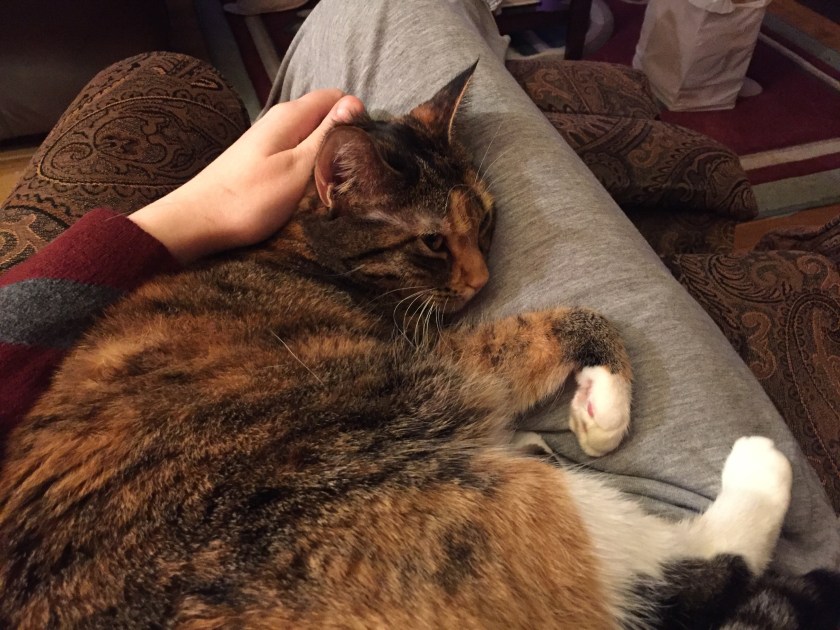
My co-worker will be a cat.

IMG_2713

Exhibit B: cat.

I will have a dedicated office space. My living room and bedroom will be off-limits until after work hours; if I have to take a nap, we have a guest room. I will engage in local activities that I couldn’t do before because they were during the traditional work day.

And most importantly — and as both Husband and my family told me for so long, it really is the most important thing — I will focus on my health.