Latest Posts

Yoga for Chronic Illness

Just thought you might like to know that this online yoga class from Aroga Yoga is available soon and is specifically tailored to those suffering from chronic pain and illness!

Everyone's a natural!

Everyone’s a natural!

There are also a couple of free videos to try. The course itself is $97 USD, which I think is great for six one-hour yoga classes, one-on-one chats with the instructor, and two group chats.

As the site says:

The Course:

-6 one-hour videos of yoga, meditation, and breathing exercises. All you need to access the videos is an internet connection and computer or mobile device!

-One to one unlimited email support for the duration of the course and 3 months afterward.

-2 group chat sessions where you can talk to me and other students in the course. These will happen twice throughout the duration of the course and you are able to ask questions and connect with others living with chronic illnesses.

Dates:

The course runs 3 times a year. The next session starts July 6!

Cost:

Huge beta discount on right now! The full course is only £60! (regular £95)

This fee gives you lifetime access to the 6 videos as well as everything mentioned above!

I’m signed up, anyone want to try it with me? Let’s light this candle!

Piss Off, Pain Management Clinics

Copy of Copy of Copy of Copy of Copy of Copy of Copy of I Forgot How To Feel Better (7)

“You have exhausted all of your options.”

That is what I was told yesterday when I was denied as a new patient at Massachusetts General Hospital. Western medicine has officially given me the heave-ho.

Sad face.

Sad face.

Because I have a “long-standing relationship with another pain management clinic,” unless I am being referred for a specific procedure that my current doctors do not have, I am not allowed to become a patient elsewhere.

It’s so strange to reach the end of the road. It’s one thing to be told that the doctors are running out of ideas; it’s another thing entirely to have someone tell you that there is literally no other procedure in existence. All the treatments they are willing to try have been attempted. Science and research have not caught up yet. This is as good as it’s going to get.

End of the road, meat wad!

Dead end, dirt bag!

What they’re willing to try. That’s the operative phrase here. Despite my decade of experience in the medical system, despite never exhibiting pill-seeking behavior, my pain management doctors refused to prescribe any kind of opioid safety net. If the pain gets really bad? “Go to the ER.”

Really? That’s the best you can offer? “Go to the ER”?

Oh yes, this seems like the perfect environment for ongoing pain management!

Oh yes, this seems like the perfect environment for ongoing pain management!

“I don’t think you understand,” I told my doctor. “I’ll have to quit my job. I can’t function like this.”

Shrug.

That’s the thing about pain management clinics. They do not cure. Most of the time they do not even have the power to manage. They try to dull the pain, to numb it, just long enough to get you out of their office. The problem is that pain is subjective. A finger slammed in a door can hurt worse than a fracture, and everyone thinks their pain is intolerable.

“I HURT SO BAD, COACH!” *Swoons dramatically*

So if you keep coming back and complaining, then the problem must be in your head. Even though I told my pain doctor that I am already seeing a pain psychologist, she insisted that I meet with one in-house in order to come to terms with the “new” me. Like I’m not letting some kid sit at the lunch table with me. Play nice, you two!

We're BFFs!

We’re BFFs! We love sparkles and sunshine!

I actually told her that when she said “you have to learn how to live with the ‘new you,'” not only did she make me want to murder everyone in my immediate vicinity, but she was also entirely patronizing. I’m sure I got some black mark in my medical file for that comment (“aggressive,” “argumentative,” “abusive,” etc.), but don’t tell me how to react to my issues when you have no experience dealing with them. I hope to God she never says those words to another patient.

Pain management doctors do not work well with patients who need more than the usual series of steroid injections. I’ve had the steroid injections, the ablations, the Botox in my muscles, the pills, the trigger point injections, the surgery, the infusion. There are no other procedures. “We’ve done everything. So why are you still hurting? It must be in your head.

Of course it’s in my head. That’s where pain is processed: IN YOUR BRAIN. My brain has learned these pain pathways, and my nervous system is constantly hyper-stimulated. It doesn’t take a Philadelphia lawyer to figure that one out.

“She has chronic pain. My fee is four thousand dollars. Per hour.”

“Give her antidepressants. Give her nerve meds. Just don’t give her opioids.” That’s the reasoning my pain doctor kept parroting: “It’s been clinically proven that opioid medication doesn’t help chronic pain.” I know that it doesn’t — not in the long run. Not if you take it every day, multiple times a day. All I need is a safety net for the really bad days. I was prescribed 14 Vicodin in March. Guess what? Still one left. Whole bottle of Tramadol? Untouched. I take them when I need them.

Doctors are more interested in protecting their own medical licenses than handing out medication to those who need it — which I can understand. If it were between my law license and some person I only see once a month, I’d go for the law license. For years, however, doctors over-prescribed until the government cracked down; now they under-prescribe and hope that none of their patients will notice. The pendulum has swung so far in the other direction that it’s only a matter of time before something breaks.

Pain management doctors must be frustrated with patients like me. It’s not like they’re huddled in a conference room, rubbing their hands together and muttering under their collective breath the names of patients they’re going to disappoint. I hate when I fail at my job. I’m sure they feel the same. But they are the gatekeepers, and they are in my way.

“So it’s agreed, then? We all hate Jen? Perfect. Course of action: Deny her any and all pain medications and insinuate that she’s crazy-pants.”

Everything that has helped recently has been found by my father, by my husband, and by me. I exercise as much as I can when the pain allows. I use a BodyBlade in order to strengthen my core muscles. I practice mindfulness and meditation. I stretch and do yoga on a daily basis. I walk at lunch. I get pain relief massages. I go to the chiropractor. I found the Quell device, which I am going to review in more detail in my next post. These are alternative forms of care, and they have been all found — wait for it — by people other than my pain management team.

We chronic pain patients truly have to be our own advocates. It is our responsibility to find the interventions that will help us. These treatments might seem strange or like some sort of hippie nonsense, but I am done being told by doctors that the pain is all in my head and that they can do nothing to help me. I will help myself. This is not the best it is going to be.

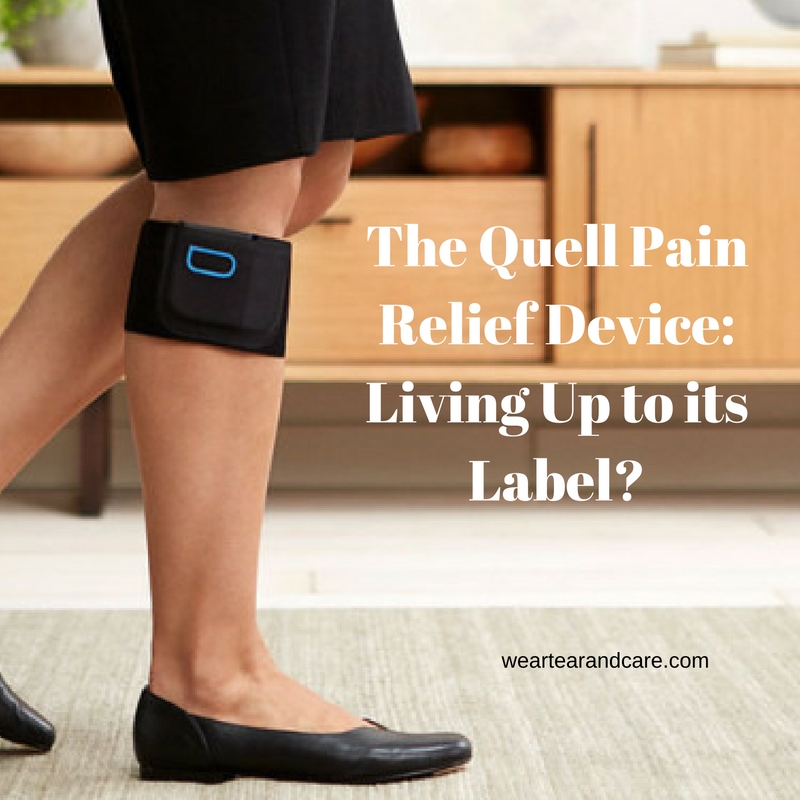
The Quell Pain Relief Device: Living Up to Its Label?

The Quell Pain Relief Device (1)

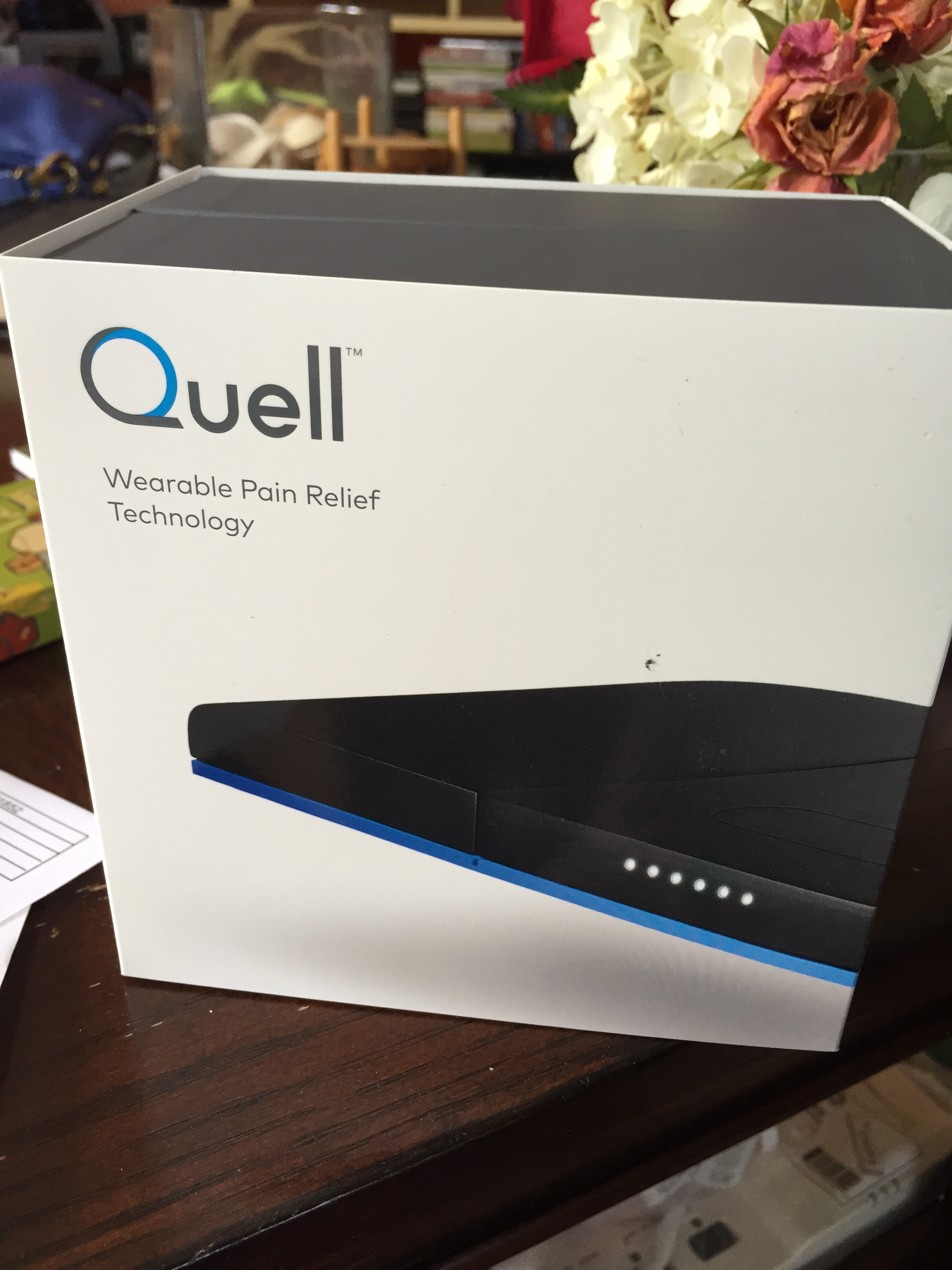
My long-awaited Quell pain relief device has finally arrived!

As soon as I saw the FedEx truck rumble by, I heaved myself out of my chair and hurried to the front door, hoping to see that plain, unassuming box sitting on the front step. There it was, as I’d dreamed for months. I basically ripped it open with my teeth.

This was 0.02 seconds after FedEx dropped off the box.

This was 0.02 seconds after FedEx dropped off the package.

I backed the Quell IndieGogo the moment I discovered it during the winter; it had already tripled its $100,000 goal. At this point my fairly useless pain clinic says I have exhausted most of my options in terms of what they can provide, unless I want to try an IV lidocaine/ketamine mix. I had the IV lidocaine infusion two weeks ago, and the aftermath was nothing short of a pain-riddled disaster. I’m grasping at straws here.

Quell makes grand promises in its sleek promotional video. As PSFK said:

TENS systems aren’t new in the market but Quell’s prescription-free, user-friendly and discrete approach is special. The Quell, no matter where the body pain is, could be left strapped at the calf where there is an abundance of nerve endings. It can also be worn 24/7 to provide round the clock pain relief.

I drowned in their website, seeking every bit of information I could. How was this device different than others on the market? How is it different than the TENS unit I already own? There are already devices worn on the calf that treat sciatica and other lower-body ailments. There are an abundance of nerve endings in that area, so it makes sense — but how can it reach the upper half of the body?

The Quell device claims to treat the entire body, producing a natural opioid-like effect through the use of electro-stimulation. It can give you relief day or night, switching on for 60-minute therapy sessions (it switches off after an hour in order to keep the user from developing resistance and switches to 80 percent power when the user is asleep). As they say on their website FAQ:

How is Quell different than other TENS devices?

Quell’s proven wearable intensive nerve stimulation (WINS) technology is double the strength of other products on the market today, enabling the device to trigger broad pain relief that covers other areas of your body. Quell’s OptiTherapy™ calibrates to your optimal stimulation level ensuring you receive maximum relief.

As it turned out, I didn’t care that I had no understanding of its schematics. I dove right in past the technical specs and the glowing media reviews.

Let's look inside!

Let’s look inside!

Dis is ma leg. LOOK AT IT.

Dis is mah leg. LOOK AT IT.

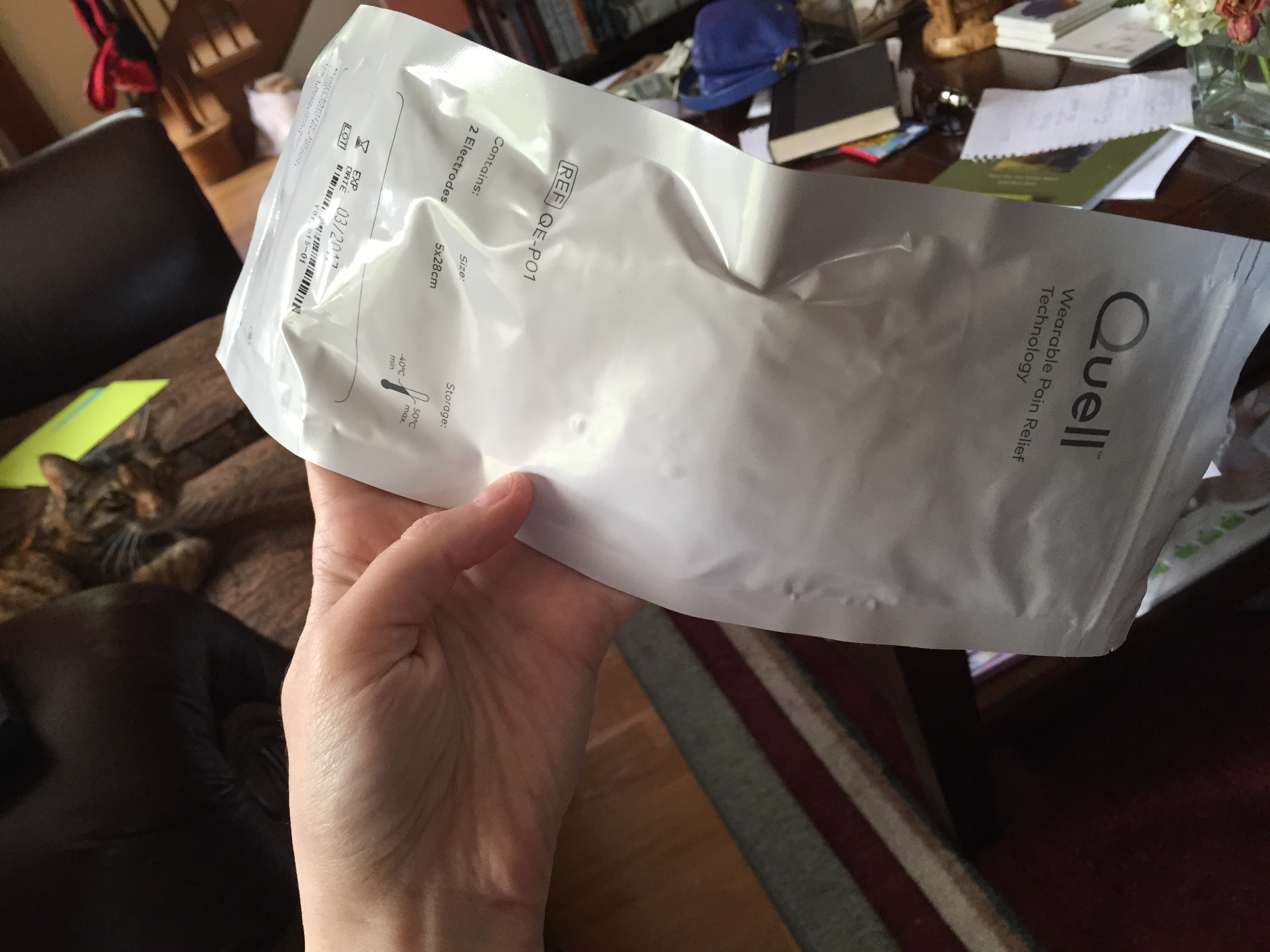
The Quell electrode lasts for two (2) weeks.

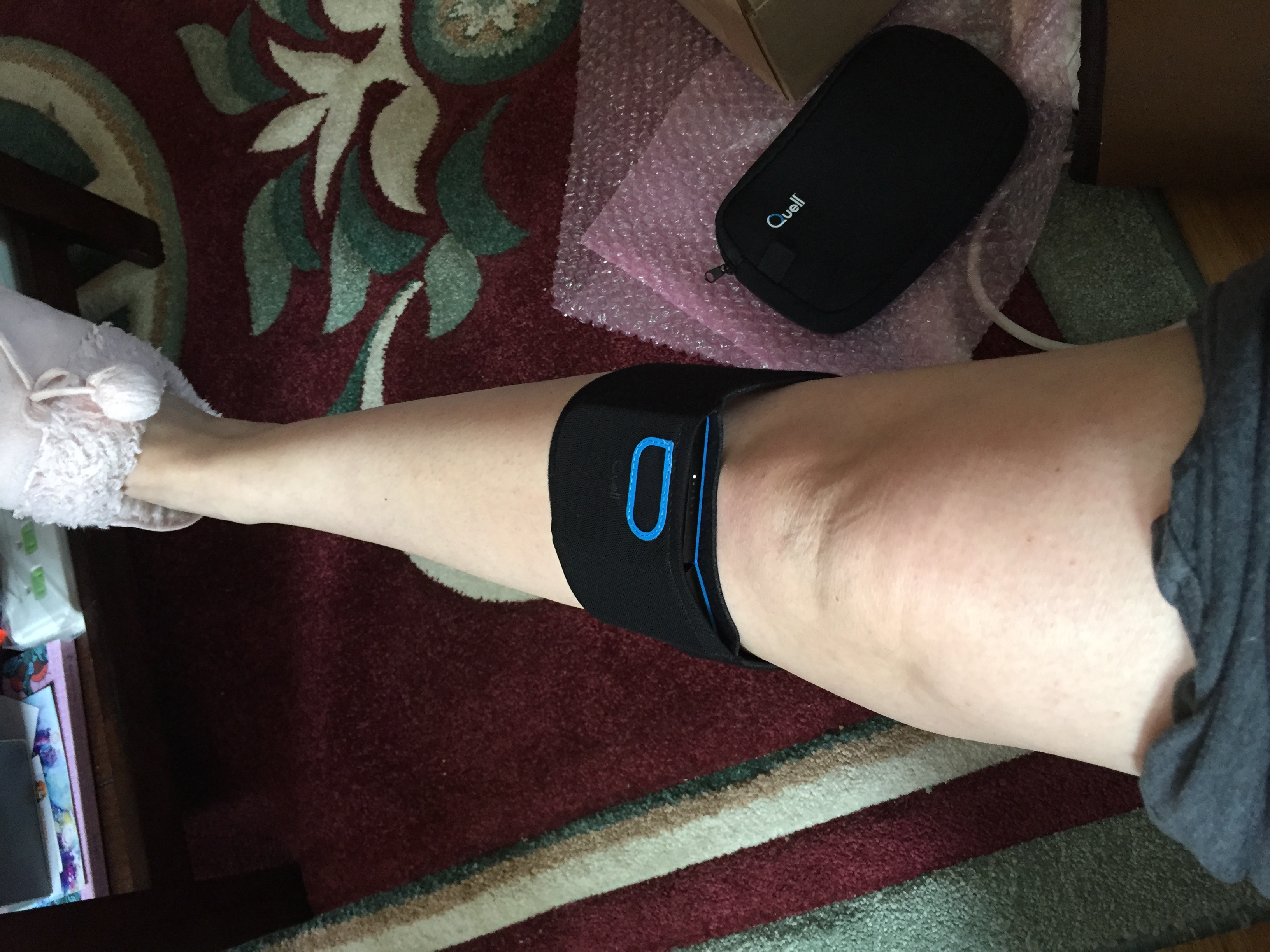
The Quell electrode, which snaps into the calf band, lasts for two weeks. Replacement electrodes cost $30. As the Quell is available over the counter for $250 and does not require a prescription, insurance will currently not cover the device or its electrodes.

I got this thing set up in less than five minutes.

I got the Quell out of the box and set up in three minutes.

Some Fattie for all of you cat lovers out there.

Some Fattie for all of you cat lovers out there. Surprisingly, we bought the couch without realizing that she blends into it.

The Quell is currently strapped onto my leg. I can feel the gentle TENS-like vibration against my calf. According to the manual, the device can provide relief in 15 minutes. The synced iPhone app states that I have had it on for 30 minutes as of this writing, but I am also reclining in a chair. I am going to attempt some movement and report back.

… FIFTEEN MINUTES LATER …

I love this device, and no, I’m not being paid for this blog post. I have 11 minutes left of my first 60-minute session. I just did some gentle yoga to test my range of motion and then enjoyed lunch on the back porch, sitting in an uncomfortable metal chair without much trouble. I can still feel the pain in my back and neck, but it feels removed. Like there’s a layer of fluffy gauze in between us. It’s like I am disconnected from my body. The tingling on my calf was distracting at first, but now it feels reassuring, telling me that something is working.

Honestly, I have no idea how this device is different than others. I know what the company says, but I don’t get how it operates. It uses “well-established TENS technology,” and I have a TENS unit. It does not feel like this, but it is somehow utilizing the same technology. The Boston Globe looked into this:

A TENS machine sends low-voltage electricity through the patient’s nervous system. In response, the patient’s body increases its output of endorphins and enkephalins, two naturally occurring chemicals that tend to reduce pain. The treatment can be an effective alternative to drugs and poses no risk of addiction.

Basically, it’s a super-TENS. It uses the cluster of nerves in the calf to send pain-blocking signals all over the body. Even after a session ends, the effect is supposed to continue for up to 40 minutes. It is to be used as a complement to a patient’s normal medication regimen, boosting up those effects and filling the gap that is not covered by traditional prescriptions or methodologies.

And now, as I check the iPhone app: “Next therapy: 18 minutes away.” I am going to keep monitoring its effects. There’s a 60-day money-back guarantee, since TENS devices don’t always work for everyone. However, I am feeling very optimistic about this product and am looking forward to that next therapy session.

IV Lidocaine: Injecting Pain Medication Directly into Your Bloodstream

Copy of Copy of Copy of Copy of Copy of Copy of Copy of I Forgot How To Feel Better (5)

It’s been a heck of a week, friends.

Friday was a trip to the pain management clinic, which — per usual — was wholeheartedly depressing. I find that I feel even worse whenever I come out of those appointments because I realize how useless they are. Pain management clinics, that is. Massachusetts as a whole is now attempting to curb prescription drug addiction. That’s great. That’s dandy. But now my clinic’s stance is that they will not prescribe opioid pain medication to anyone except for cancer patients. We’re talking even something like Tylenol 3, which my pediatrician used to prescribe to me after the First Accident. Patients who’ve (responsibly) used Percocet or Vicodin for years are now finding themselves wanting and in withdrawal. Actual pain patients are being treated as addicts.

So I get my nerve medication and antidepressants, but then the big gaping black hole they don’t cover is alive and writhing and screaming in my head all day, every day. When I asked how to handle that hole, the nurse practitioner, oblivious to the fact that she has never experienced a decade’s worth of pain, actually had the gall to say, “You have to learn to live with the new you.”

Pretty close to my actual reaction.

Pretty close to my actual reaction.

I could’ve kicked her teeth in, but that probably would’ve been labeled “pill-seeking behavior.” This is also what she said to me before my spine surgery, so I decided to take a year-long sabbatical from their clinic until I became too complicated for my surgeon’s pain management office. I didn’t want to start all over again with new doctors, so I returned, my pain now widespread and diffuse.

The problem is that there is no specific genesis for this pain I have. It started in my neck and back, sure. But now it’s in my head. It’s in my legs. It’s in my arms. It snakes throughout my trunk. How do you treat that? You can’t just inject something and expect it to reach the rest of the body.

Except you can. You can do an IV of lidocaine, apparently. That is what Monday’s adventure was. The pain team infused me with three syringes of lidocaine, which can at most be repeated once a month, and at its best will last about three to four weeks. The goal was to calm down my central nervous system enough for me to function properly. Sensors were applied to my chest so they could monitor my heart rate, and the blood pressure cuff kept constricting my arm every few minutes.

During the procedure? Heaven.

I SEE THE LIGHT

< Insert choir of angels >

The drug was injected over the span of about twenty minutes. The doctor kept asking me questions, waiting for side effects to kick in — which happened almost immediately. I swooned back into the pillow on the hospital bed, wagging my tongue around; it’d gone numb. My face was tingling. My eyes slid around in their sockets like pool balls. Suddenly every word I tried to say became a picture in my head, and the spaces in between sentences, in between syllables, became gargantuan. They came out of my mouth like a trail of drool. My body was jelly and seeped down the cot, collecting in a puddle on the stark white sheets. They kept asking me what my pain was on the normal one-to-ten scale. I started at about a six; I slurred my way to a one, which I haven’t experienced in more than ten years, and then ended at about a three. I was crying. The pain was almost gone. The pain was almost gone.

But not for long, naturally. Barely an hour after the procedure, once Husband had poured me into the car and then chauffeured me home, the base of my head was alight. My spine was crackling with fire. My hands and feet were jolting. What I think happened was that once they stopped injecting the medication, my body went from zero to sixty. No pain to all the pain. I spent the afternoon and evening snuggled up in bed with Fattie, waiting for the lidocaine to stop swirling around my bloodstream and settle down like the doctors said it would.

Hi there, Fattie Ding-Dongs!

Hi there, Fattie Ding-Dongs!

Now it’s Thursday. Tuesday was all kinds of awful. Yesterday I was better, I actually felt good. And today, I’ve crashed. It’s been an emotional week, to say the least. It’s hard to have your hope dashed over and over again. The worst part is that this pain clinic said if the IV lidocaine doesn’t work, they would attempt an infusion of lidocaine mixed with ketamine. If that doesn’t work… shrug.

Sucks to be you!

Sucks to be you!

It’s been a very trying time for both Husband and me. It’s difficult to stay optimistic when it seems that the pain management clinic is being so thoroughly unhelpful, refusing to prescribe pain pills in order to protect themselves from government crackdowns. The problem is that modern medicine doesn’t understand pain very well. It’s entirely subjective. Every person experiences it differently, and what is trite to one individual might crush another.

Every day this week has been depressing, so guess what? We’re ending on kittens.

I know you'd eat my corpse if it came down to it, but good God, you are all adorable.

I know you’d eat my corpse if it came down to it, but good God, you are all adorable fluff monsters.

Building a Shield for my Body and Mind

I am trying to better protect my body, which means trying new things in order to build a stronger shield on all fronts. My father found a powder supplement called “Arthroben,” which is generally used for those suffering from arthritis and other inflammatory conditions. For some reason the company decided that their original flavor should be green apple, so it tastes like I’m eating a Jolly Rancher (yes!) that I dropped in the sand (no!). I have also increased my Cymbalta by 20 milligrams, which I’m not thrilled about, but hey, what can you do.  Judging by my Pain Tracker instead of my shoddy memory, it’s been a fairly good week. Once I stabilize on the new dosage of Cymbalta, I will attempt to transition off the 2oo milligrams of Lyrica that I take each day.

Soon I'll be getting rid of some of these sneaky bastages! (Ten points if you get that reference.)

Soon I’ll be getting rid of some of these fargin’ sneaky bastiges! (Ten points if you get that reference.)

I am also strengthening my body to the best of my ability. After a week of no exercise because of being symptomatic, I am easing back into my morning swimming routine where I doggy-paddle (or I do Aqua Aerobics with the old ladies and token old gentleman, which is actually super fun).

This is me.

This is me.

The evenings are difficult because I’m generally wiped out after working all day. This exhaustion is more to do with sitting for hours at a time and the commute; even though I have a kneeling chair and a recliner in my office (because my bosses are awesome), I’m usually in some sort of spasm by the time I get home. However, I still try to do gentle restorative yoga, and now I have the Body Blade, which was also suggested by my father (he started in athletic training before transitioning to physical therapy and then integrative manual therapy and now his own new holistic work). It’s essentially a yard stick that you shake, and the vibration coupled with resistance engages the muscles. I thought it was ridiculous until I used it for ten minutes and woke up the next morning feeling sore in all of those places. So hey, new toy!

I have also come to realize that my mood has a significant effect on my physical state. This past Memorial Day weekend was spent unplugging from work and having amazing adventures with Husband. It was fabulous, and I felt great despite my body’s chronic quirks. We went to lovely restaurants, tromped through nature, played at a farm, explored Walden Pond, watched movies, and just enjoyed each other’s company. It makes me want to dedicate time each day to unplugging. Just being.

We were sickeningly adorable.

We are sickeningly adorable. Also, this isn’t us.

This past weekend also meant FOOD. Lots of food. We went to our favorite restaurants, found a new vegan/gluten free place, and ate all the junk we normally would not because we were on staycation. We needed no justification and ate to excess. But now, on the other side of staycation, I see the huge amounts of sugar I was eating. I have long known that I am unable to control myself around sugar and carbs. When I eat dinner, I have to end on something sweet. When I unwind in the evenings, I find myself in the kitchen two or three times. This is not a good pattern for me, mainly because sugar is so inflammatory, it adds to my waistline, and it hides in literally every damn thing I like to eat. I need to cut back. Excess weight on my frame only hurts my back, and sugar only burns my nerve endings.

This is my mind whenever I try to meditate.

This is my mind whenever I try to meditate.

More than just protecting myself, I want to be nice to myself. I want to be friends with my body. I view my pain as a separate, distinct entity. For instance, when I was swimming this morning I felt an alarming twist in between my shoulder blades. I eased out of the movement and asked myself, “Okay, what’s going on there? It’s all right, calm down.” And I realized that I was talking to this pain as if it were someone else. This is me.

Hey, at least I'm TRYING.

Hey, at least I’m TRYING.

I said in a previous entry that I am not my pain. However, I am my injuries. I am this body. And that’s okay. I can do my best with this body. Kim Manfredi, a successful yoga teacher whose story is eerily similar to mine, said it best: “I am my injuries and my brokenness is what makes me… me.” She knows that her spine, broken in four places at age 18, cannot perform certain movements. It’s just a fact. Her right leg is partially paralyzed as well, but that doesn’t stop her from running seven yoga studios and practicing daily. She finds the magic within the movements, the beauty within the strictures.

This is not Kim, though I imagine Kim has moves that are even more gorgeous than this one.

This is not Kim, though I imagine Kim has moves that are even more gorgeous than this one.

More importantly, she has moved past her anger. I sent Ms. Manfredi an email months ago explaining my situation and how poisonous rage was coiling through me. First of all, she wrote back — which was awesome. She said that it has taken her thirty years to begin to write about her pain, and not to worry if some days the symptoms flare and you can’t practice yoga or swim. Some days are good. Some days are bad. Some days are “meh.” You move through them. Considering I have gotten through 100 percent of my bad days, I’d say my chances of continuing that streak are good.

I still complain sometimes. I still get into black depressions. I still ask the universe why this happened to me and not to, say, someone in the Westboro Baptist Church. But now I’m writing about it. I’m reflecting. I’m being mindful. I’m breathing into my pain. I breathe it out. I am moving forward.

Mindful Anger Management, Buddhism, and the Neck TENS Unit

More and more often, I am trying to figure out what this blog is to me. Is it just the tagline, “Using word therapy to work through chronic pain”? Is it an effort to reach out to people like myself and form a network? Is it a chronicle of my wayward pill-reducing efforts, or is it an examination of my transformation from a bitter young thing into a self-aware individual who can control her own anger?

Cats in general embody hatred and bitterness. I love them so.

Cats in general embody hatred and bitterness. I love them so.

I can’t control anything. That’s the first bit of wisdom I would like to impart upon you, my dear reader(s). I’m sitting here at my desk with a neck TENS unit on (it’s pretty rad, and with it looking like a choker, I’m feeling very early ’90s). I can work the buttons on the device, but it only temporarily blocks the pain. It does not fix it.

We manage. That’s why pain clinics are called “pain management.” They do not cure your pain; it is only managed. As I said in a previous entry, this current state might be the best it gets for me. I know that my physical condition is fluid, even if it moves at the pace of molasses going up a hill in January. This pain right now is not forever.

So if I am trapped within those strictures for the time being, what else can I do?

Mindful anger management.

Rock on, kid.

Rock on, kid.

This is taken from a PDF that has no author so I don’t know how to credit it, but you can find the download here:

How do you become aware of anger before it becomes that intense?
Meditation, meditation, meditation
which leads to
Awareness, awareness, awareness.

Furthermore:

How Does Anger Work?
Learn how anger works so you can work with it and not be worked by it. … [P]sychotherapist Richard Pfeiffer, Ph.D. … describes anger as a chain reaction starting with a situation that causes you physical or emotional pain. He explains that pain triggers thoughts that cause you to blame someone or something for that pain, while your brain is sending signals to other parts of your brain to prepare you for fight or flight.

Anger hurts. When you hold onto the rage, the bitterness, it percolates inside of you until it’s boiling and it’s like oily, black ectoplasm shoving its way up your esophagus until it wrenches apart your teeth and explodes outward.

And one more block quote, mainly because this article is fantastic:

1) Learn and practice mindfulness meditation; 2) Reduce reactivity; 3) Give yourself permission to feel and access your anger; 4) Learn how to express anger and to release anger’s energy in a non-destructive way; 5) Stay as present as possible in every waking moment, especially when you feel your temperature rising; 6) Shift your attention to your breath to calm yourself until you are past the point of no return; 7) Once you’ve reached boiling point, mindfully remove yourself from conflict and only return to the discussion once the anger has been released and you feel calm; 8) Find a therapist for extra support and guidance in learning how to work with your anger.

1) Mindfulness meditation: I am using the Buddhify app and reading up on Buddhism. It actually makes sense to me in a way no religion or practice does.

2) Reduce reactivity: I can snap into anger as quickly as it takes to sneeze.

3) Give yourself permission to feel: I do that. I don’t squish my feelings into a little box like the rest of the Irish can. It’s impossible.

4) Express in a non-destructive way: I like to think that I am very civil and mature when I express my anger. I don’t break things. I don’t yell. I just dwell on things… forever.

5) Stay present when anger is rising: I’m usually caught on the wave of feeling and am far from the present shore when I’m angry. I have to work on this.

6) Focus on breathing: Um… I have to work on this one, too.

7) Remove yourself from conflict: …………………

8) Find a therapist: I am seeing one tomorrow. I shall report back with my findings.

Nominated for the Very Inspiring Blogger Award

Hey there, folks!

So I’ve been nominated by dimdaze for the Very Inspiring Blogger Award. Thanks so much, Don! Go check out his blog. Right now.

RULES:

– Thank the person who nominated you for the award. (Again, thanks, Don!)
– Add the logo to your post.

Wa-chaaaaaaaa!

Wa-chaaaaaaaa!

– Nominate ten (10) bloggers you admire and inform them of the nomination.

I nominate the following lovely writers:

  1. myfridayblog.wordpress.com
  2. oldmamoon.wordpress.com
  3. lilypupslife.wordpress.com
  4. thecutecraftytoad.wordpress.com
  5. faloolar.wordpress.com
  6. moderndaywarriorprincess.wordpress.com
  7. emmavlangridge93.wordpress.com
  8. cynicaljaded.wordpress.com
  9. changeispossibleblog.wordpress.com
  10. doilooksick.com

Names Have Power: a Discussion About Labels and Chronic Pain Patients

Copy of Copy of Copy of Copy of Copy of Copy of Copy of I Forgot How To Feel Better (6)

I have long believed in labels. If there is a name for what I am experiencing, I am better equipped to fight it. If I know what I am, I can deal with the world appropriately. Names have power. That’s what Neil Gaiman’s version of John Constantine said. He said it for different reasons and toward a different end, but the fact remains: Names have power.

I have collected labels and names over the course of my life: allergic to food/has eosinophilic esophagitis/is a good student/played tennis/played the violin/writes novels/is a lawyer/is disabled/is a chronic pain patient.

I define myself by what I do and what I experience. The names are like a shield.

Let's pretend that this is me.

Let’s pretend that this is me.

A medical ID bracelet naming my allergies makes me feel special and fragile like a unique little glass-winged butterfly, and more than that, it’s a story. I love to tell stories. A scar on my throat is a symbol that others recognize. I have been broken apart and welded back together. I have been remade.

So now I face a dilemma because the surgery is complete and there is no further need for immediate surgical intervention — my doctors have no idea what boxes to check or where to put me on the Western medicine playing field. Last week I saw a rheumatologist at Beth Israel who said, “Why are you here? If I could wave a magic wand, what would you want me to do?”

This is my confused face.

This is my confused face, though I am actually not made of Twizzlers.

Well, Doctor, since I have widespread pain, my hands don’t work properly, and you’re supposed to be an expert on that, I would like you to take the pain away, please.

His response: “Chronic pain syndrome of some sort. Let’s dump you on the pain clinic. Now get the hell out of my office.”

“GET OUT, PEASANT!”

(Those might not have been his exact words.)

Googling “chronic pain syndrome” is like bobbing for apples while wearing dentures; you’re not going to be very successful. It’s too close to fibromyalgia, the infamous kitchen sink diagnosis of exclusion (“You don’t have this, this, this, this, or this, so you must have fibromyalgia”). It’s like complex regional pain syndrome, but not quite. It’s similar to myofascial pain syndrome.

But what the hell do I actually have?

I don’t know how to react without labels. It’s impossible to prepare for battle. Living in an undiagnosed state is tantamount to floating in limbo. You remain in stasis until a doctor unveils a treatment that can yank you back through the wormhole. The trick is being able to move forward in life despite not having a name for what you’re going through. That’s the hard part. I haven’t been very successful at just being me. Who am I, under all of these labels and names?

TheDiaryofaSickGirl noted something extremely relevant to this discussion:

I heard a fantastic quote while listening to the TED radio hour on identity stated by Andrew Solomon. He said “As long as you experience your condition as an illness it’s a prison, and once you experience it as an identity, it’s the source of your freedom.  If we can treat illness as identities we liberate people into experiences of great joy that would otherwise be closed to them.”

I have some sort of chronic pain syndrome. Okay. I can buy that. But I disagree with that quote on a fundamental level, which is the fact that while I have this pain, I am not this pain. This pain is not me. It is not my identity. By giving it a name, by making it my identity, I give it too much power.

I am not chronic pain syndrome. I am not eosinophilic esophagitis. I happen to have these problems. They are not my identity.

I am not my pain.

Let’s Talk About The TENS Unit

Copy of Copy of Copy of Copy of Copy of Copy of Copy of I Forgot How To Feel Better (4)

I’m a huge advocate of clothing camouflage. Loose shirts and cardigans are great to hide a flabby stomach or that back-fat area around a tight bra strap; however, I’m wearing them to hide both a back brace and a TENS unit. (And the bra fat. Let’s be real.)

Here’s me in my extremely stylish office bathroom:

Hellooooo! (Reluctantly copyrighted by J. W. Kain.)

Hellooooo! (Reluctantly copyrighted by J. W. Kain.)

I usually only wear the TENS on occasions when my back pain is truly escalating and refuses to level off. This week has been particularly bad. The TENS is keeping me at a functioning level, considering I am backing off the Lyrica. The electrodes irritate my skin after more than one use, which is unfortunate, but the only cost-efficient way to use the device is to reuse the pads until the gel wears down and the pads electrocute you. Tiny shocks to be sure, but electrocutions nonetheless.

Side note on the electrodes: Don’t go through the supplier from which you acquired the actual unit. My insurance company holds the very ridiculous philosophy that while they will cover the device, they will not cover the electrodes. Tufts, you silly company, the device does not work without the electrodes. Going through Empi was far more expensive than getting similar pads on Amazon.com, where I could A.) buy them in bulk and B.) get free two-day shipping. (Husband doesn’t like Amazon.com because of vertical integration, but I love me some Amazon Prime.)

Here’s a stupid story for you. About a year ago I woke up early one morning because I was too uncomfortable to sleep. I snuck out into the living room, accompanied by Fattie. It was about 5 a.m. on a Saturday.

Fattie is always so happy to be with me. (Joyously copyrighted by J. W. Kain.)

Fattie is always so happy to be with me! (Joyously copyrighted by J. W. Kain.)

I’d just gotten the TENS unit from my spine surgeon’s office at one of my post-surgical followup appointments. I’d tried using a similar device a few years before, but I had not enjoyed the experience. It was too bulky, too noticeable. I remember trying not to cry as my father hooked up the wires and placed the electrodes on my back. This one, at least, was smaller. I was in my bathrobe and fumbling with the electrodes, tired and working in the dark, when somehow it turned on while my finger was attached to the sticky pad.

I was Thor in a lightning storm, electricity coursing through my body. Fattie meowed at me, like, Food? Wat u doin? I needs food, Mama. And all I could think was, I had to get the cat to be quiet so Husband wouldn’t wake up. This wasn’t lightning-strike electricity; this was therapeutic electricity. And it hurt like the dickens.

Somehow I managed to whip my body around and fling the electrode off, where it went SPLAT on the floor. Fattie went over and started investigating while I smacked the power button on the device. And that was how I learned to never, ever turn the TENS unit on while the electrodes were not in their proper positions.

So here’s how I wear the TENS and the back brace:

Those shirts can hide a lot. (Deviously copyrighted by J. W. Kain.)

Those shirts can hide a lot. (Deviously copyrighted by J. W. Kain.)

For your reference, I am 5′ 7″ish tall. I currently weigh about 157 pounds, which refuses to go down despite exercising and diet because of my medication increasing my appetite and a metabolism that is slow as molasses going up a hill in January. However, there’s a lot of clothing magic I can still perform. Like with dresses!

I talked about this in my first post, but let’s revisit the topic. Clothing and medical devices can be hard. Even Googling it is difficult; I had to finally search for how people hide insulin pumps. Those are generally smaller than TENS devices, but the principle is the same. Other smart people have spread the word as well and offer advice: Clip it to the front of your bra. Wear a garter under your dress. Hook it up to your belt. There are even pump bands. I have always been partial to Ruthanna Kuhn on Etsy; her lace garter belts are perfect for wearing a TENS under a flared dress. Or for carrying a gun. You know. Whichever.

Wearing a medical device can feel embarrassing. I have an overweight friend who doesn’t like being out in public because people stare at her. Those sidelong glances from people when she goes to the gym feel as obvious as laser beams. That’s how I sometimes feel when wearing a TENS unit. I feel like everyone can see everything about me. Or they just look at me and wonder what’s wrong. What’s the matter with her? 

It’s gotten to the point where I’m defiant about it. Sure, I’ll go into a changing room at the gym in order to place the electrodes on my back, but then I’ll walk out in my pants and bra to the main locker room, my back brace fully visible, my wire and electrodes exposed. I see people glancing at me, trying to be subtle while they dry their hair and sneak glances in the mirror. It doesn’t bother me anymore. Yes, I’m pretty much bionic. This is me. This is what I need to do.

So I put on my shirt, throw on a cardigan, and start my day.