Well, hey now! This is a lovely report from Beta Boston saying that after 60 days, 81 percent of Quell users (in a study following 88 patients) have experienced less pain!
Hot diggity damn!!

This dog is cautiously optimistic regarding these results.
Well, hey now! This is a lovely report from Beta Boston saying that after 60 days, 81 percent of Quell users (in a study following 88 patients) have experienced less pain!
Hot diggity damn!!
This dog is cautiously optimistic regarding these results.

Check out my new Pain News Network column on the Amethyst Richway Biomat!
Some pain relief modalities are unusual to the point that they’re out in the stratosphere. It’s also true that some products only work for some people. Just because a device doesn’t offer visible results the first, second, or even third time doesn’t mean it isn’t working.
That is why I have to keep an open mind and not make snap judgments based on concepts, websites, or promotional material.
Like, for instance, today’s topic: thermotherapy and the Amethyst Richway Biomat.
Amethysts?
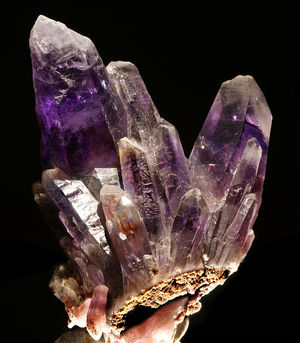
Yes, amethysts — February’s birthstone — can also be beneficial in thermotherapy.
When speaking specifically about the Biomat, I should warn you that Richway’s website isn’t slick. The idea of amethysts being associated with anything health-related is out of most people’s comfort zone.
But hey, I’ve used the Biomat for upward of five years and fall onto it whenever I have sore muscles, which is constantly. It’s such a fixture in my life that at first I didn’t even think to discuss it. So here we go!
The Biomat. Behold:

This version is the full-body mat covered with a sheet. Underneath my head is the Biomat pillow. Each session can last for five minutes or twelve hours, depending on how much time you have available. The heat can reach temperatures of 158 F° degrees. Read on to find out why that number means absolutely nothing when it comes to treating pain.
The FDA has approved the marketing of the Biomat for a whole host of things: relaxation of muscles, improvement of circulation, temporary relief of muscle pain and/or spasms, and much more. There are specific range settings for certain medical conditions, though it is generally safe.
The science involved came to being when Drs. Erwin Neher and Bert Sakmann discovered how ions flow in and out of cells, which they called the “ion channel theory.” The two scientists revolutionized the field of cell biology and won the Nobel Prize in 1991 for their shared research.
If you’re like me, you have no idea what this means. However, this ion channel theory is put into play by the Biomat’s use of negative ions, which is then complemented by far infrared spectrum therapy (or thermotherapy, like what is found in saunas) and the amethysts embedded in the outer layer of the mat. These stones have been used for thousands of years for everything from fighting the evils of drunkenness to helping with meditation.
In modern times, researchers discovered that amethysts can carry an electrical charge. (Readers, are you still with me? Hang on, we’re almost there!) So, the infrared rays pass through the amethyst layer of the mat and then become “long wavelengths capable of safely penetrating the body as deeply as seven inches.” This heats up your core body temperature, encouraging your body to detoxify.
To put all of this in English: The Biomat creates an environment in which the patient can safely enjoy negative ion therapy and infrared therapy.
What does this mean for the person actually flopped onto the mat? It means a yummy, delicious, low-grade heat. And low-grade does mean low-grade, even if it can reach 158 F° degrees.
One time, my husband wanted to use a heating pad on a strained muscle and cranked it all the way up to eleven: “Honey, I don’t think this is working. I’ve maxed it out and it’s still not warm enough.”

That’s because it doesn’t generate heat the same way a traditional heating pad does. It gets toasty, sure, but you couldn’t cook meat on top of it. At its price point, you certainly wouldn’t want to cook any sort of food on it.

I mean, look at the controls. It’s like the cockpit of an airplane.
For me, the Biomat doesn’t present a dramatic “Before and After” picture. It’s not like Tiny Tim could throw away his crutches after using this product. I can’t think of things I couldn’t do before that, with the Biomat, I can do afterward. Even so, I would never stop using it.
This product is just better than a heating pad. When you hurt all over, you want something that reaches all over. Those of us with chronic pain, we use a plethora of heating devices and creams and patches in order to soothe sore muscles. The Biomat, while extremely expensive, is a full-body restoration and relaxation device. Even the mini mat fits into a chair and covers a lot of real estate.
At the end of a long day, I look forward to sitting on the Biomat. I sleep better when I use it; in the summer, for instance, even a low-grade heat is too much for me, and I go to bed feeling stiffer and more rickety, like a broken marionette. Those are the days I truly notice a difference. Studies have been conducted regarding thermotherapy and resulted in pain decreasing significantly (concurrently with anger and depression). It has even been used to treat cancer.
So does one recline upon the Biomat and come forth as a new person? No, not after one session, two sessions, twelve sessions, or fifty sessions, but you absolutely do feel better. Your muscles are soothed. Your knots unwind, even just a little bit. Your pain is quieted for a time. And that’s enough for me.
Today we have a guest post from the lovely Anna of Migraine Brainstorm. Anna has been a spoonie for three years, suffering from chronic migraines. However, when she isn’t in pain, she teaches English, crafts, paints, and writes. Check out her work on Twitter, Pinterest and Instagram, and contact her by email: anna@migrainebrainstorm.com.
~~~~~~~~~~~~~~~~~~~~~~~~~~~~~~~~~~~~~~~~~~~~~~~~~~~~~~~~~~~~~~~~~~
Do you find yourself on the couch most Friday nights? Perhaps conducting deep and lengthy conversations with a pet, or desperately searching for a new quality series on Netflix? Maybe you have cancelled plans to hang out with some ice packs, a heating pad, and a big fat pile of meds? Well, you are not alone!
Er… except that you are, probably, literally alone.
Chronic pain has the capacity to change every affect every aspect of a person’s life, and Friday nights are no exception. Before my extended run-in with pain, I happily maintained a robust network of friends. From besties to casual acquaintances and everything in between, I cultivated the full social calendar of an extrovert. I would happily invite 30-odd people to a party and then happily host them until well past midnight. Imagine! I could and did go out for drinks after work, and I would travel across town without worrying whether I’d have the energy to get back home. Of course, all that has changed, and now my social life looks quite a bit different.
I will acknowledge that all relationships are in a constant state of change however imperceptible from the inside: regular ol’ unpredictable life makes sure of it. However, with a sudden change in abilities — such as any dramatic twist — these differences can come on so quickly that it can be hard to adjust with any sense of normalcy.
The biggest game changer is that chronic pain or illness can often mean that our energy is limited, and whether we measure it in marbles, battery power, or spoons, we’ve only got so much to spend. Thus, necessities must often take precedence over fun times. If a relationship used to revolve around common interests such as exercise, exploration, late nights, drinking, travelling, or any kind of boisterousness, that relationship can land on the rocks in the event of chronic pain or illness. And if a past relationship was one in which the spoonie frequently used act as a caregiver or visitor, the relationship might be whisked right out to sea.
From a spoonie’s perspective, it can be unendingly frustrating – or even devastating – to watch friends, family, and even lovers fall by the wayside just when we need consistent love and care more than ever before. It can be tempting to add guilt to the mix when that little voice in the back of our heads blames us for not being the person we used to be. It can also be tempting to push ourselves to mask our pain or fake it to maintain some semblance of the relationship that once was. We might also be angry with others who are unable or unwilling to meet our needs. But none of these knee-jerk responses are usually very helpful. So what is?
For me, being conscious of, and able to articulate my needs has been the first step in reassembling and maintaining any sort of social life. I let people know that my energy is limited, and that if they want to see me they probably need to come over (and then get the heck out before 10pm). They will need to avoid yelling, smoking, and wearing perfume. They must not insist we listen to music. They must not hate me if I cancel at the last minute. Some people have been able to adapt to this. Others haven’t.
Building new common interests has also been key in making sure I’m not a total social recluse. The friends with whom I used to go dancing late at night in loud places with booze and such? They still dance, but we play cards together and have games nights. We’re addicted. Some friends have not been able to adapt to this new hang out routine.
Since my travelling abilities have been reduced, some long distance relationships have been maintained through Skype and phone chats instead of in-person visits. Some friends have been great about this. Others haven’t.
Friendships that are contingent on my ability to give time and energy and spontaneous support? They have faltered.
Do I miss some of those friends who don’t fit into my new routines? Yup. But what I’m finding out, however callous it might make me, is that I don’t miss them that much. What I really need is a core group of folks I know I can count on, who love me, respect my limitations, and are willing to meet me halfway (…or 9/10ths of the way). The people who can’t do that? They’re going to find other ways to satisfy their needs as I have, and that’s just fine.
Relationships change all the time with any infinite combination of circumstances. I refuse to feel guilty or sorry for myself because of mine, and I pledge to find ways to maintain a support system that doesn’t leave me alone every Friday night.
How do you maintain a social life despite chronic pain or illness?
The Huffington Post published an interesting article with new statistics on the disabled: One out of five Americans is disabled, and one out of every eight has mobility issues. Check it out!
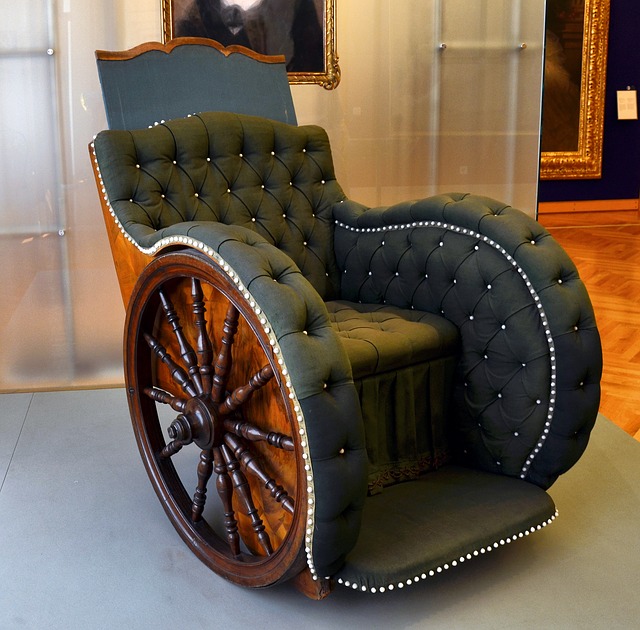
“They see me rollin. They hatin.”

Pasted below is the content of my first column as a regular contributor for the Pain News Network!
When presented with the Quell pain relief device, people make one of two assumptions about me: 1.) I injured my knee, or 2.) I am a paroled felon wearing a very forgiving Velcro GPS.
As I said in my recent guest column, I have made it my mission to test as many pain relief products and therapies as possible. Some of them might be familiar to you; others will be of the “new and bizarre” variety. Whatever they are, I will be your Friendly Neighborhood Guinea Pig and review them for your convenience. I only draw the line at “Made for TV” products that are out to swindle the desperate consumer.
Pain patients are certainly desperate. We have a constant refrain humming through our bodies that plays a different tune for each person. Doctors are the musicians taught to hear those tunes — but how can they possibly learn all the music? How can they hear your specific song and have the knowledge necessary to fix it?
The problem is that sometimes they cannot. They are deaf to your pain just like that one whale who sings higher than every other whale — none of them can hear her.
Thus far, doctors have been unable to hear the song that thrills along my nerve endings. This leaves me with no choice but to fend for myself. I could take the route at which they have hinted: find some street drugs and wait for the undertow to take me (not that this is the problem the media makes it out to be). Or I could travel a different road and at the same time realize that this life of mine includes pain. If I can’t get rid of it, I can at least muffle it.
As I said recently in my blog — Wear, Tear, & Care — I have been trying the Quell pain relief device, which is made in the great state of Massachusetts (i.e., my backyard). I have been using it every day for more than a month. Here are my findings:
This is all well and good. But how does the Quell work?
According to their research paper presented to the FDA, the Quell works not unlike other devices that latch onto a dense cluster of nerves in the upper calf. Generally it is best for lower-body pain (sciatica and the like), diabetic neuropathy, and fibromyalgia. I myself have fibromyalgia-ish symptoms, since my pain radiates all over my body. However, I apparently do not actually have the inflammation that is fibro’s hallmark. Doctors will only commit to “chronic pain syndrome.” Since the device works for me, I can say confidently that it treats more than those three conditions.
The Quell is twice as strong as conventional TENS units, does not irritate the skin like traditional electrodes, is less conspicuous, has a mobile app, and can be worn at night. (They say it can be worn at night; I personally found the stimulation too distracting.) It activates endogenous opioids in the body (natural opioids, to say it in English), a different system than the one on which prescription opiates work. It is, simply put, a wearable intensive nerve stimulator that follows the Pain Gate Theory: The impulses generated by the Quell block pain signals from reaching the brain. As it was cleared to be sold over-the-counter, it is currently not covered by insurance.
I know you pain patients out there loathe the numbers system (“What is your pain on a scale of 1 to 10?”). I also despise it; this is the only one that has come close to working for me. That’s why I have created a new system. Instead of assigning an arbitrary number to my pain, I am going to tell you what I can do now that I couldn’t do before.
FINAL DIAGNOSIS: The Quell device has worked brilliantly for me. While it doesn’t get rid of all the pain I feel, it dampens enough of it so that I can more fully live my life. I hope that it can bring others as much relief.
If you’re like me, then you dread weather patterns and barometric pressure changes. You can feel the effects of a rainstorm swelling in your body, and maybe you pretend that you’re a superhero with poorly-controlled weather powers (again, if you’re like me).

“Sorry guys, my aim is reeeeeeally bad.”
For more than a decade I have been able to predict rain with 99 percent accuracy. Humidity decimates me. The cold can find me in several sweaters and a non-ironic Snuggie. I have touched on this topic before, but now that we have experienced the hottest day of the year so far in Massachusetts and the humidity refuses to abate, I ask myself: Why on earth do I live here?
This would protect me from ALL THE HEAT.
Seasons are, generally speaking, difficult for those of us with chronic conditions. Our fragile bodies are unable to handle random, drastic weather changes. That’s why it confuses me when the elderly flock to Florida… like birds. It’s humid down there. Short rainstorms occur almost daily. The heat is intense.

“What’s the thermostat set at? 85 degrees? Crank that sucker up.” — everyone’s grandmother, probably.
Whatever my reasons, I choose to stay here. So how do I deal with the seasonal onslaught of Mother Earth?

Just a normal July.
Other than that, I sit inside and fear the sun, just like our ancestors did.

“Why does the day-ball burn us?!”
It might have been a car accident. Maybe you overextended yourself during a gym class. It could have been a sneeze gone wrong. Perhaps it was caused by trying to put on a pair of pants. In the end, though, you might just be getting older. You wait for the pain to get better, but it doesn’t. Weeks turn into months, months turn into years. Doctors’ faces blur together. They try this, that, and the other thing — and it might help for a little bit, or not at all. Whatever the reason, you are now one of the 1.5 billion people worldwide who has joined the Chronic Pain Club.
This clubhouse is like the cover of a politically correct college textbook.
It is kind of a club. And at this point, in a strange way, I am thankful for my membership.
I’m not being facetious. Obviously I would prefer not to be in pain, but hey, here we are! A couple years ago, I would have smacked myself for saying that I’m thankful for what this experience has taught me — I would have groaned to this bizarrely optimistic person that the pain is so bad, it’s all-consuming, it is the world. You just don’t understand.
It gets exhausting, though, fighting your pain. You’re essentially fighting yourself. For ages I attempted to stave off the pain, to push it away. I’d do (almost) anything to numb it. I wanted to be the me that didn’t have pain. I wanted to be the me from before.
As I said recently, I have reached the end of the Western medicine road. Though there are always new discoveries, I need to come to terms with my current situation. This is what I have learned:

Doctor: “You sound great. Or maybe you’re dead. Hell, I don’t even know what this thing is called.”
Not just living, but thriving. I have to produce things. I have to be creative. I have to make this life worthwhile. I have to learn how to do that despite my current limitations. More than that, there has to be some sort of point to all of this. There used to be a reservoir of ever-present stories in my head, sparkling ideas that I would snatch down from the sky and spin into books. Since being doped on antidepressants, I can’t access that creativity. But I refuse to just sit in my recliner at home, not thinking, not doing, not being.
Once I realized that this chronic injury is part of me and that it can teach me things I otherwise would not have learned, I was able to climb out of that oily pit and see things clearly for the first time in more than a decade. I found myself at a loss, though. What do you do when you’ve reached the end of the road? Where do you go? To whom do you turn?

You have to fight for pain relief, obviously. Doctors have closed the door on traditional methodologies like medication, injections, and ablations. You tried those. They didn’t work. You even start to doubt yourself: “Is the pain really that bad? Maybe I’m overthinking it. Nobody is taking me seriously. They think I’m just being difficult.”
Doctors even ask you to see a pain psychologist in order to make sure you aren’t seeking secondary gains. Maybe you actually like being chronically ill because of the related “perks”: getting out of work, having an excuse to stay home, and being able to ignore relationship obligations. Maybe you’re just seeking attention. Maybe you like being the brave survivor.

Unless my time spent at home is as relaxing as it is for this puppy, then 9 times out of 10, I’d rather be at work.
Thankfully, my pain shrink has nixed that idea with me. I feel terribly guilty when I have to go home early. I don’t like talking to my friends about what’s going on with me. I miss being able to do fun things with my husband — especially on a whim. The level of planning involved when dealing with chronic pain is absurd.

I’ll just leave this here.
So what do you do?
You become a researcher.
Being in the Chronic Pain Club teaches you many things — you know yourself better than you ever could have dreamed; you know your real friends; you learn your limitations and how to push past them; you find joy in life’s details; you learn to say “no”; you see beauty in impermanence; you find new activities and new reasons to live; and you know that nothing is forever, not even your pain.

Heck yes!
However, that is not enough. It is you against the medical society. Nobody else will fight for you the way that you need to fight. If doctors can’t control the pain, you need to find ways to control it yourself. Otherwise, life stops. You drift through existence, waiting for the next moment of relief. I have decided that I can’t do that anymore.
That being said, I am pleased to announce that I have been accepted as a columnist for the Pain News Network. This online publication seeks to give a voice to those suffering from chronic pain and illness. I will be reviewing medical devices and different therapies. If doctors can’t help me, then I’m going to help myself. I am going to try any and all therapeutic modalities. Even the weird ones. I’ll try exercise routines. I’ll try alternative healing. Whatever it is, whatever you’ve heard, I will try it. Have a weird remedy that your grandma swears by? Send it my way. Heard about a Turkish traction device? Toss me the link. If it doesn’t work, fine! Then I’ll have saved time for somebody else in my situation. The one thing I will not do? Offer false hope.
Husband offered up the topic for this edition of Word War Won (which, sadly, has not been on the radar for quite some time). To refresh your collective memory, WWW is when I delve into the meanings of words that we use and how some words are better than others for those working through chronic pain. It helps to re-frame negative thought patterns into positive ones (like the techniques used in cognitive behavioral therapy).
Careful: adjective. [kare-full] The state of avoiding potential danger or mishaps.
Mindful: adjective. [myend-full] To be fully aware and present in the moment.
I was reading through some of my medical records when I came across a shrink’s blurb who’d made a point of noting that I am afraid of interacting with the world. To paraphrase: “She is scared to go out in crowds, and in the wintertime she thinks that if she is not careful, she will slip on ice and injure herself further.”
I might as well live in bubble wrap. For the record, I have tried. Please refer to Exhibit A below.
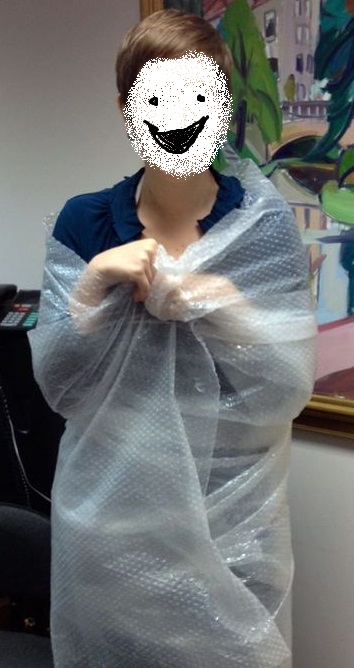
That actually is me. You’re welcome.
Husband framed the idea nicely. His physical therapist told one of her other clients to be careful when going for a hike or something. She corrected herself and said to the client, “Be mindful.”
There is a large difference. Being careful brings to mind being tentative and timid. You shuffle forward slowly instead of taking confident steps. You are in a constant state of apprehension. Being mindful, on the other hand, means that you are aware of your actions without being afraid of them as well. The mind doesn’t wander; it is fully attentive and precise. When you are in that state, there is no need to be afraid.
A great article by Psychology Today just came out about mindfulness. When you are in the shower, do you think about the water droplets running over your skin and the way that feels? The heat as it sinks into your tense muscles? The relaxation resulting from that release? No, you’re thinking about your day ahead (if you’re a morning shower type of person) or you’re thinking about the day you just had (if you shower at night … or twice like me, because it feels delicious).
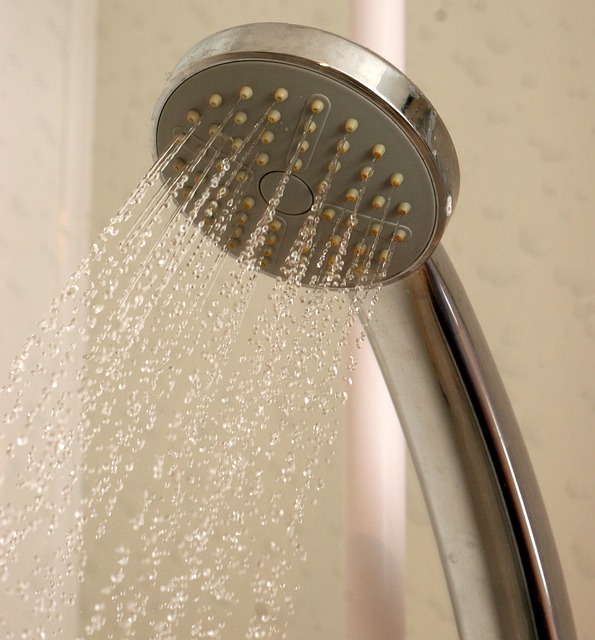
Being careful in the shower, conversely, means not dropping the soap.
Carefulness is about fear; mindfulness is about presence. There’s that old saying (which Google tells me is actually from Michael J. Fox?): If you have one foot in the past and one foot in the future, you’re pissing on today.
It doesn’t pay to be afraid, even if you have a chronic illness. Wistfully remembering your pain-free/illness-free self won’t do you any good. This is you — this is now. You have this pain, and no amount of wistful remembrance is going to do anything to change it. In fact, the only thing it will do is make you miserable. And fearing the future (“Will I get worse?” “Is this the best it’s going to get?” “What if I never get better?”) does nothing to benefit you, either. Medicine moves at a startling rate. There is no telling what will be approved by the FDA in one month, six months, one year, or five years. Hell, I wrote that post about western medicine shutting the door on me, and days afterward I saw that article about MGH and their new pain scanning system.
Life is glorious suffering. Our meat sacks degrade from the moment we are born. As soon as we are born, we start to die. Somewhere between the beginning and the end we are going to be battered and bruised, broken and bashed. Some of us get better. Some of us don’t. But because we can be hurt, we also have the capacity to heal. Our state of being is constantly changing. If you felt bad yesterday, you might feel better today. You could even feel better tomorrow. Pain is not forever. It does nothing but harm you to be afraid of what is coming, and it only hurts worse to cling to what you used to be.
Mindfulness de-magnifies pain. When you are hurting, it can feel like that pain is the entire universe. By giving the pain precise attention, you can tease apart what is catastrophic thinking, what is fear, what is anger, and so on — until you are left with the pain itself. By then, it’s not quite so bad.
To give an example: Being careful while hiking evokes an image of moving slowly, testing surfaces before putting any weight on them, and fearing what lies ahead. Maybe there are bears. Nobody wants to be alone with a bear.

“I will eat you and all you love.” — Bear.
Being mindful while hiking means that your steps are sure. Your attention is undivided. You are focused on the ground in front of you and the scenery around you. Should you come across a bear, you will have the presence of mind to back away slowly instead of fleeing.
THE WINNER: BEING MINDFUL!

It’s really hard to draw with MS Paint.
A New Kind Of Brain Scan Can See Your Pain, Literally | Popular Science.
Definitely worth a read for those of us with pain complaints that have no obvious outward signs!

I have now been using the Quell pain relief device for 15 days. Here are my initial thoughts:
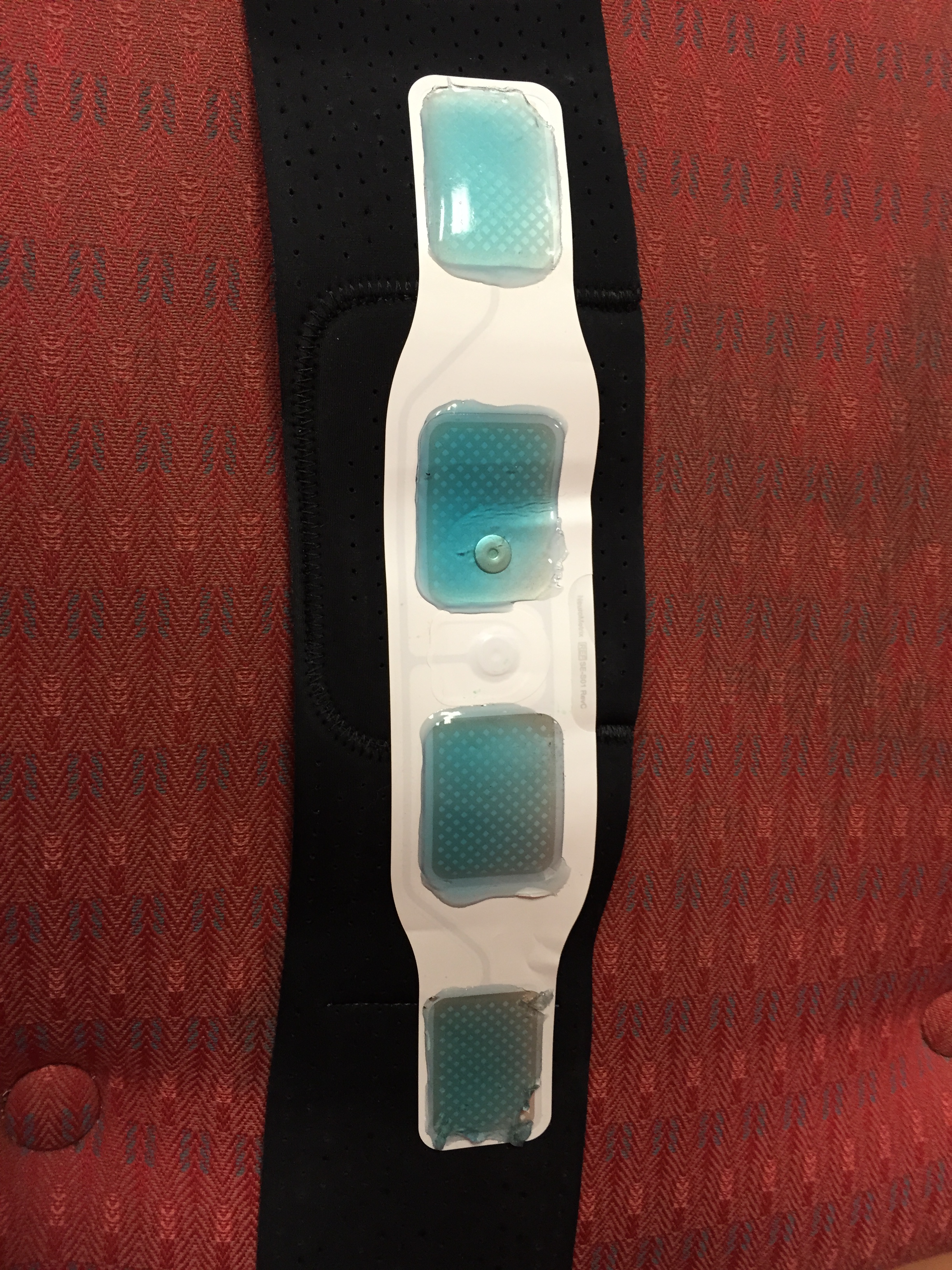
Five days of daily wear.
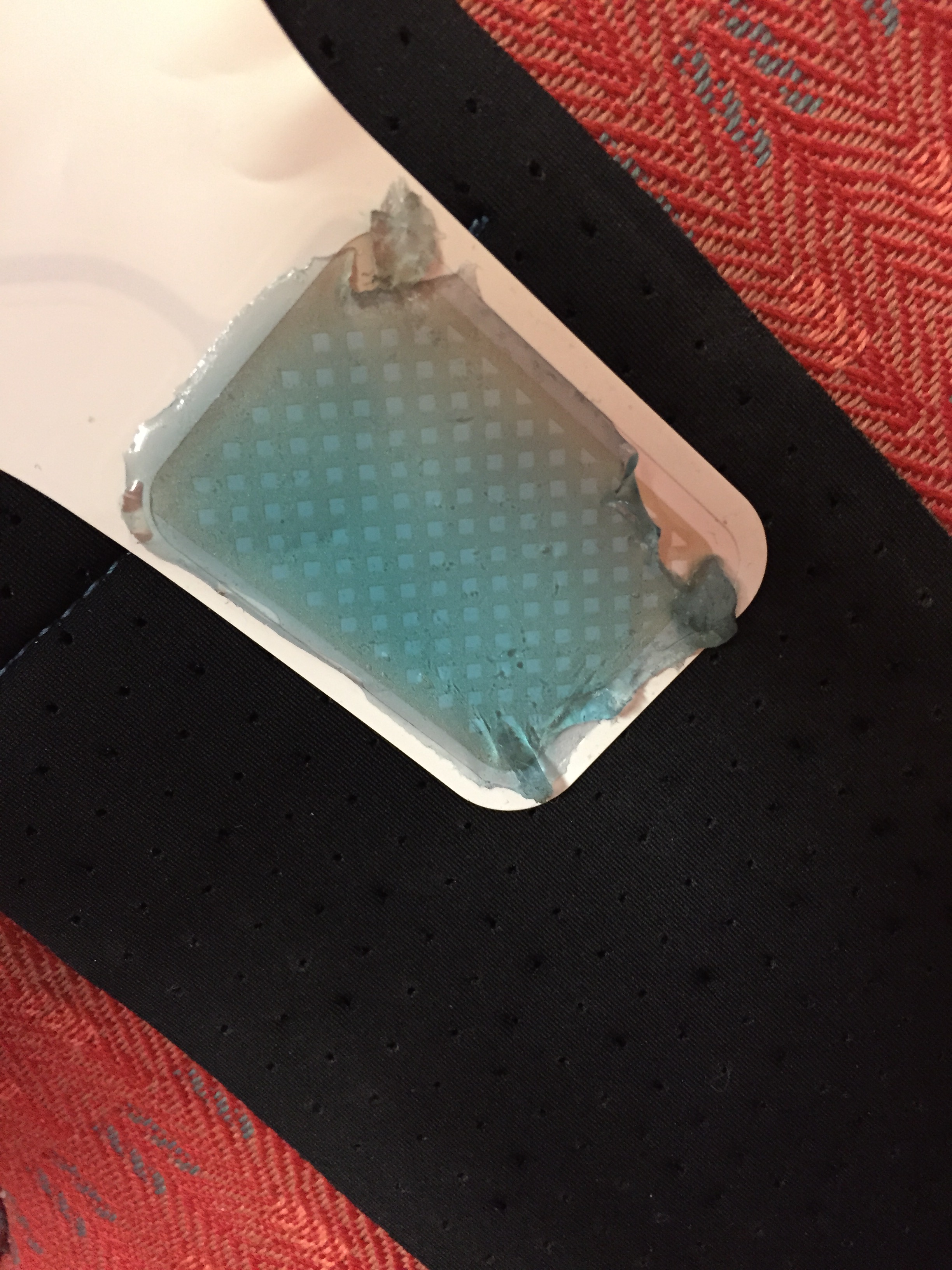
Closer look at the gel in question. When the gel ripped off, I would just plop it back on.
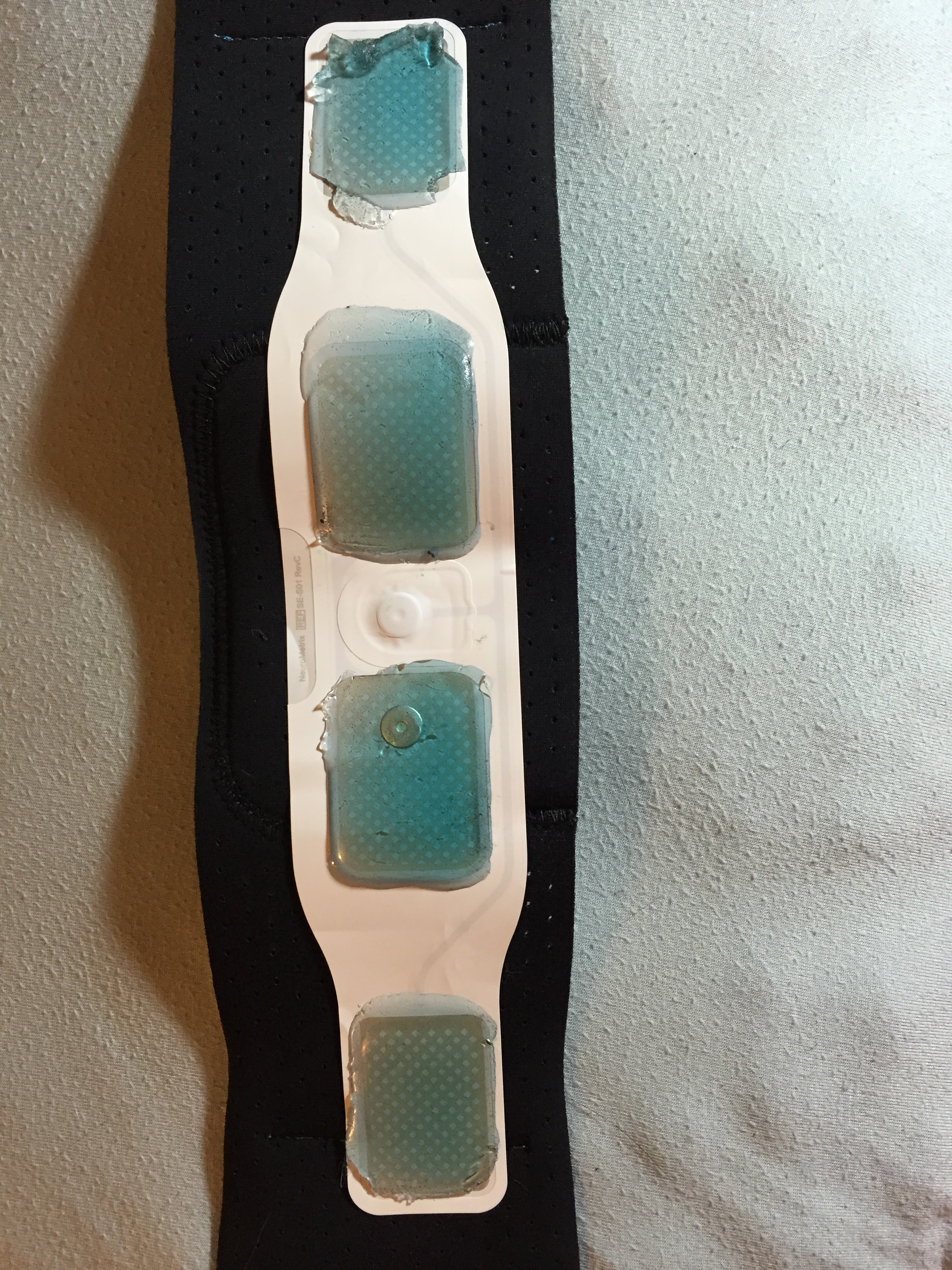
Taken after 15 days of daily wear.
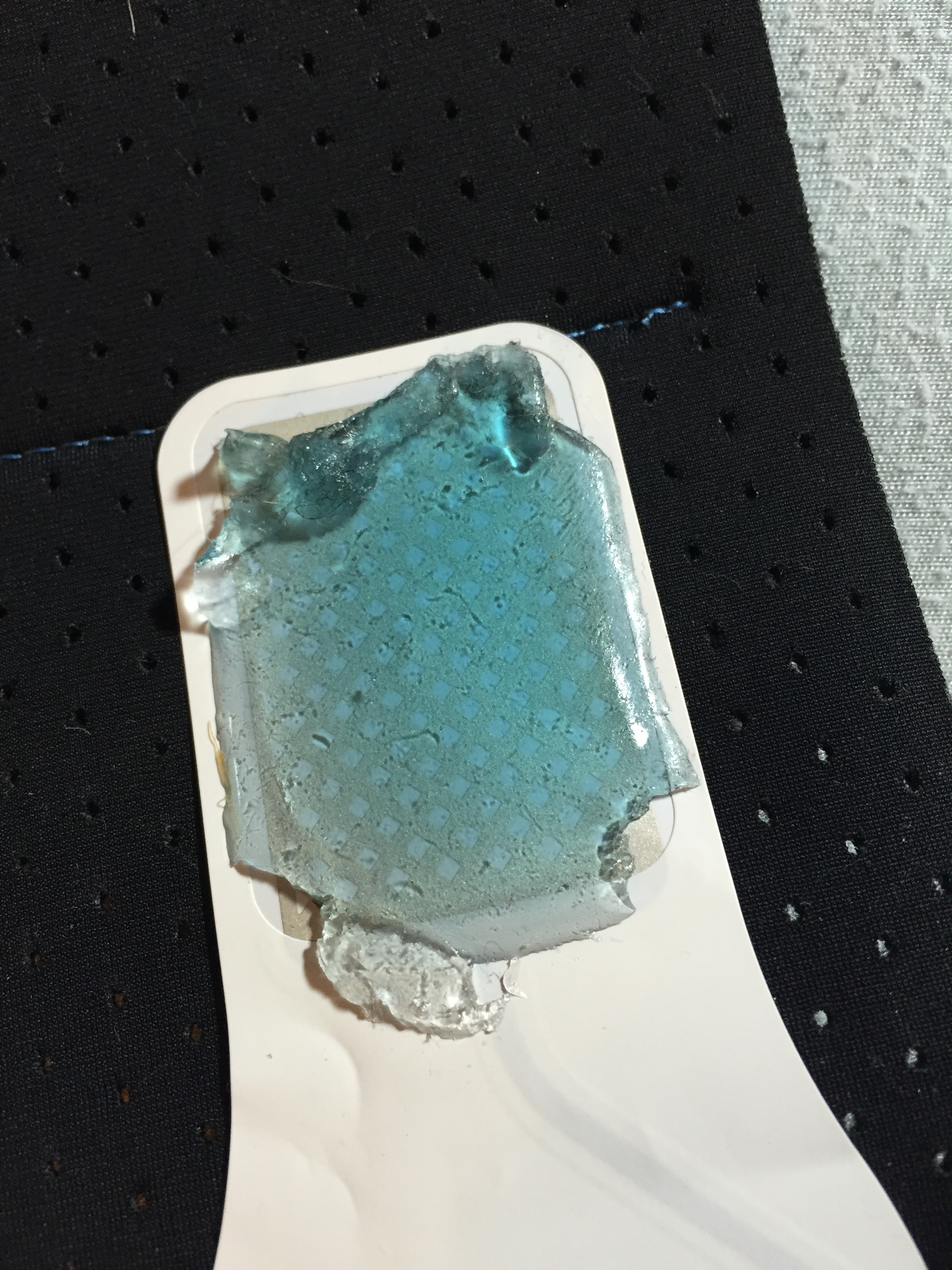
Compared to the wear and tear of normal TENS electrodes, this result ain’t terrible.
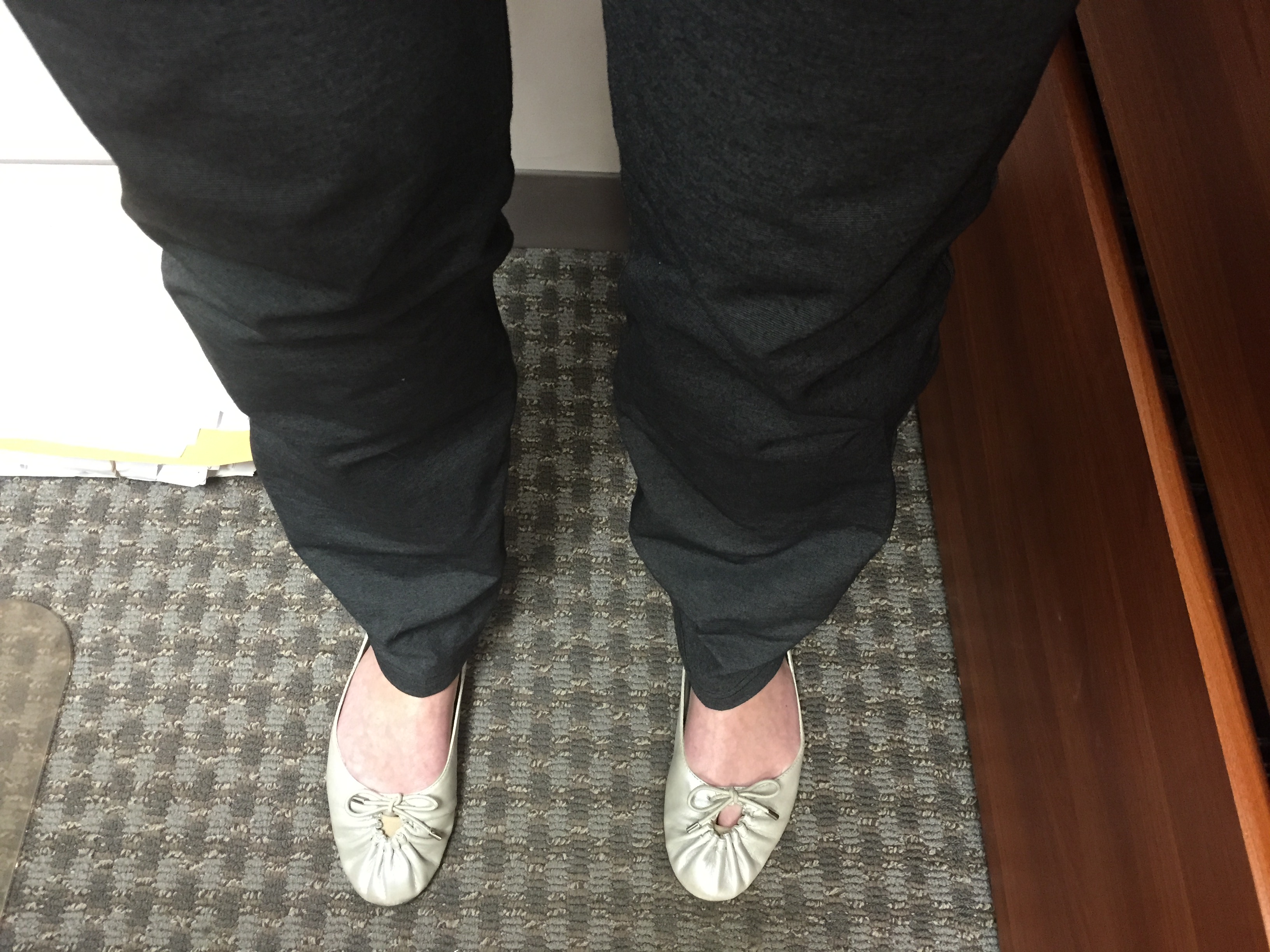
Not my most flattering angle. But which leg has the Quell on it? Can you tell? Nope!
All in all, I am giving the Quell a gold star. Anything that helps me get through my already difficult work day is fine by me. This is less conspicuous than other TENS units, and I feel it is far more effective (for me, anyway).
I was finally able to find a section of Quell’s website called “The Science Behind Quell,” which is a fascinating read.
From what I understand, when TENS units were introduced in the 1970s, they were originally used to determine which patients would respond best to implantable nerve stimulators. Their overwhelmingly positive reception indicated that there was a need for these intensive nerve stimulators, though not everyone was a candidate for the surgery. This led to wearable intensive nerve stimulation, or WINS.
WINS follows the “Pain Gate” theory, which states that peripheral nerve stimulation closes a gate in the spinal cord and blocks off pain. As the report said,
[a]lthough it is activated by localized peripheral nerve stimulation, the descending pain inhibition system has analgesic effects that may extend beyond the stimulation site to provide broad pain relief.

Wat?
Simply put, even though the device is placed on the calf (“My calf doesn’t hurt,” you might think), the pain gate theory means that it can still produce a calming, opioid-like effect on the rest of the body by using “endogenous opioids,” or naturally-occurring opioids in the body. They work through a different opioid receptor in the body than prescription drugs do. That being said, if someone has developed a tolerance to Vicodin, for instance, they might respond favorably to a WINS device because it works through a different receptor in the body.
I am responding favorably to the Quell. Recently I was having a bad day and had to take half a Vicodin for the first time in a long while. As that familiar opioid sensation flowed through my body, I compared it to the Quell. The pill took effect faster, but it did not last. I felt lazy and tired, just a lump in a recliner. I was useless. Though it calmed my pain, it also made me not care about it. Or anything else, really.
The Quell lets me function without compromising my brain. I have more energy to get through the day. I can think. It doesn’t take care of all the pain, not by a long shot, but it takes care of enough of the pain that I can pretend to be a real human being. And for now, that is enough.

 Wear, Tear, & Care