Latest Posts

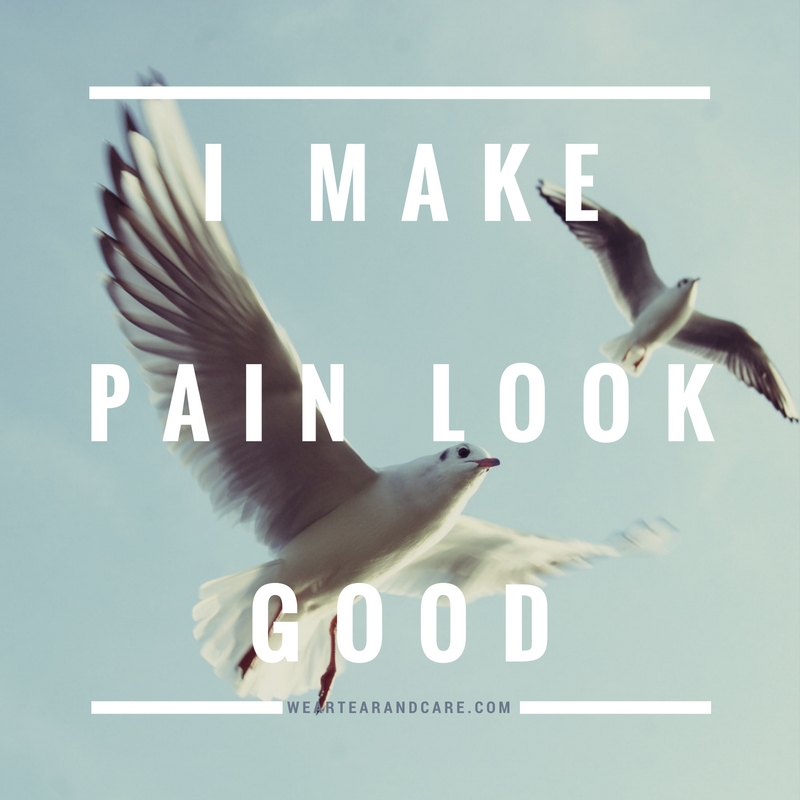
I Make Pain Look Good.

Copy of Copy of Copy of Copy of Copy of Copy of Copy of I Forgot How To Feel Better (1)

Take a look at this person.

Because she's all about that bass. (Conceitedly copyrighted by J. W. Kain.)

Because she’s all about that bass. (Conceitedly copyrighted by J. W. Kain.)

Take a real good look.

Then ask yourself: Is this person in pain?

She looks fine, you think. She doesn’t have a handicap placard on her car. She doesn’t walk with a cane. She isn’t wearing a brace.  You furrow your eyebrows, and then you think: She looks totally normal. 

The thing is that when this picture was taken, she was in a world of pain. She had three sort-of healed spinal fractures and a calcified nerve cluster. Even though she was smiling under the artful disguise of Microsoft Paint, she was hurting. She was wearing a back brace under that dress. She changed into flats as soon as that picture was taken. She found a place to sit down and close her eyes, trying to match her inhales and exhales to the thud-thud-thudding of her spasming muscles. She had her special dichroic glass pill case in her handbag filled with Tramadol, Nabumetone, and Vicodin. She had already calculated how long she could stand being upright and the time it would take to get back to the train that would shepherd her home where she could flop into bed and succumb to the black wave.

Conversely:

DEFIANTLY COPYRIGHTED BY J. W. KAIN.

HAPPILY COPYRIGHTED BY J. W. KAIN.

Does she look like she’s in pain? That is the eternal question. Those of us who hurt, we participate in the world because we don’t want to be left behind. If we do things, we pay for it later. But we don’t want to be left out.

And we always have the “Pain: The Motion Picture” soundtrack playing along in the background of everything we do.

Whenever I’m out and about, I look at other people and wonder what their pain is. Maybe it’s a herniated disc or a bad knee or a bunion. Maybe it’s an old skiing accident or just the echoes of sleeping wrong. The ghosts of our experiences build us, layer upon layer, into who we are. Those seemingly small problems grow and swell and consume us because of their actual enormity. To us, they are infinity.

So next time you see someone park in a handicapped spot and get out of their car with apparent ease, hold off on the judgment. I could be that person. I qualified for a handicap placard years ago. I qualified for disability earlier this year.

And yet I look totally normal.
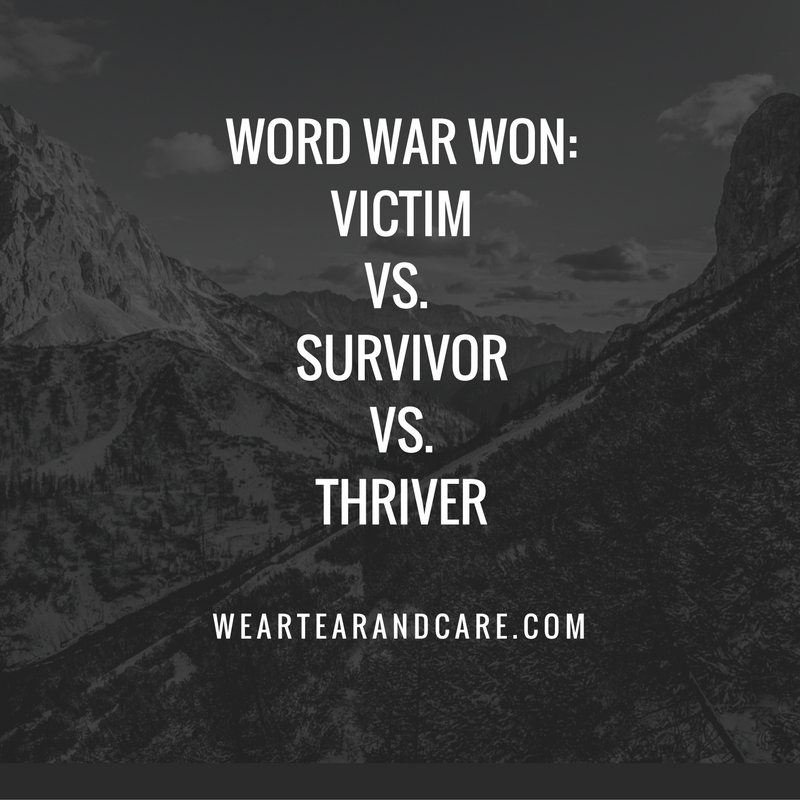
Word War Won: “Victim” vs. “Survivor” vs. “Thriver”

Copy of Copy of Copy of Copy of Copy of Copy of I Forgot How To Feel Better (4)

I was going to talk about different words during this edition, but Alexis got me thinking. We had a very uncomfortable session the other day during which she asked me how things are going now that I’ve cut out sugar and alcohol. It started last week when we had a Skype session and she saw my face. She said I needed to do a detox. Immediately.

I felt slow and inflamed, my brain was foggy, and even my face looked puffy. I’d gone to a small law school reunion/memorial for my friend Andy and saw surprise on my classmates’ faces; the last time they saw me was thirty pounds ago. (Granted, some of that weight gain was necessary at the time since I was an anthropomorphic coat hanger, but do you know how hard it was just now to type “thirty pounds ago”?) My pain was worsening. I’d been gaining weight despite exercising every day, thanks to my medication increasing my appetite to that of a starving boat wreck survivor.

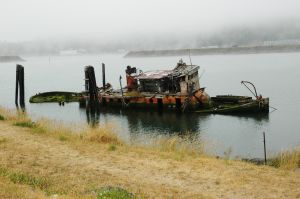
"I know we're only ten feet from the shore, but I am STARVING." (Courtesy photo.)

“I know we’re only ten feet from the shore, but I’m STARVING. Johnson, you’re taking one for the team. It’s been nice knowing you.” (Courtesy photo.)

I’d binge in the evenings after work, thinking I deserve this as I snatched up the box of Cinnamon Chex. It felt good at the time, but later that night I would always hurt more.

Alexis asked if I had to slowly wean off sugar and alcohol, or if I could go cold turkey. I’ve never been good at anything but extremes.

Surprisingly, it hasn’t been hard. This is day 8. I’d been expecting a monstrous headache like when I stopped drinking coffee a few years ago (a deprivation that has, thankfully, been rectified). My father said I might crash after a week on this diet, which happened at about day 5. Pure, undiluted exhaustion dogged me throughout the day.

Anyway, Alexis asked how things have been going since I cut out the sugar and alcohol. I was very remote during this in-person session (wordplay!) and resistant to our discussion. She sensed this and called me out on it. What was I resisting?

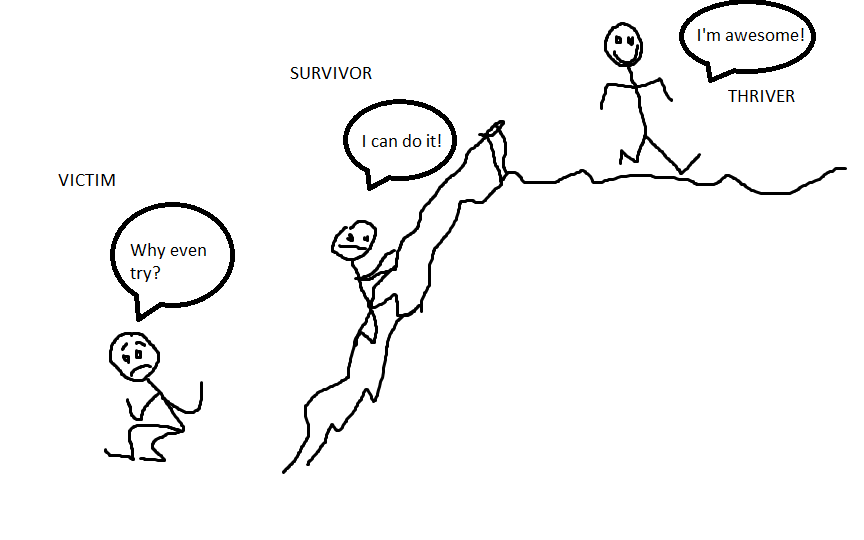
It had to do with three words: victim, survivor, and thriver… the last of which apparently isn’t a real word, but who cares. She asked me which one I have been and which one I was now.

VICTIM: noun. [vik-tim] A person who suffers in some way, who complains about his or her given circumstances and does not attempt to alter them.

SURVIVOR: noun. [ser-vayh-ver] One who stays alive and claws his or her way up from the pit, bloodied and exhausted, and who will continue to fight.

THRIVER: noun [thrayv-er] Not a real form of the word “thrive.” One who prospers and flourishes, expanding beyond confines and living life to the best degree possible.

From the time I was 17 to maybe 25, I was a survivor. I’d broken my back as a teenager. There were definitely periods when I was a victim, asking the universe why this had happened and being all “woe is me,” but mostly, I just went about my life. (Those around me might heartily disagree.)

When I was rear-ended the second time, the very instant that car hit mine, I became a full-blown victim.

I cried a lot. I sank into a very dark depression and withdrew from everything around me. It’s like I was covered in black gauze. The momentary spark of hope I got when I was scheduled for a cervical fusion was dimmed when the months went by and I did not improve the way I’d wanted or at the rate I’d expected. So for years now, I have been a victim.

I was resisting this discussion because I didn’t want to admit that.

Since starting this blog, I like to think I’ve become a survivor again. My mood has changed drastically; for once I am actually optimistic. I feel hopeful, and I’ve come to realize that self-perception is everything. Even when I have bad days now, I don’t see it as a continuation of a years-long hell hole; I see it as a temporary arc upward on the pain scale. It’ll settle back down. It always does.

The winner this week?

See, he's... you know, he's climbing a mountain... a very short mountain... TRIUMPHANTLY COPYRIGHTED BY J. W. KAIN.

See, he’s… you know, he’s climbing a mountain… a very short mountain… TRIUMPHANTLY COPYRIGHTED BY J. W. KAIN.

THRIVER wins, obviously, but survivors are not lesser beings. Survivors are busy surviving. They have more important things on their minds. Once the smoke clears and they are able to see, only then can they even think about thriving.

Embracing Pain with Mindfulness

Copy of Copy of Copy of Copy of Copy of Copy of Copy of I Forgot How To Feel Better

Is it better to ignore pain or embrace it?

I thought for the longest time that by meeting my pain head-on, I was doing myself a good service. And it’s true; ignoring pain can be emotionally and mentally taxing. If I embraced the pain, I would be able to discover the edges of it. Then I could encase it in a box within my mind, if that makes any sense. I’d be able to get outside of my own head. Surely this was better than ignoring how I felt? Better than pressing onward despite feeling like a train was chug-a-chug-a-chugging along my spinal column?

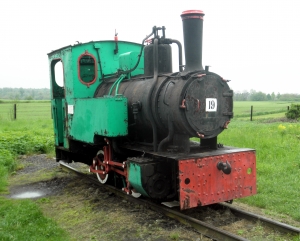
"Ladies and gentleman, we apologize for any inconvenience, but we are now going to stop at every local station between here and California for no reason whatsoever." (Courtesy photo.)

“Ladies and gentleman, we apologize for any inconvenience, but we are now going to stop at every local station between here and California for no reason whatsoever.” (Courtesy photo.)

After the first accident, I thought that I’d felt the worst pain I could ever feel. After the second accident, naturally, I realized that the pain can get worse. The pain can always get worse. And where before I could feel the edges of it, after the second accident I was burning inside, burning outside, just burning. I tried to face it; instead, I was directed by it. If I turned too quickly and felt a hitch in my ribs, I’d immediately settle into my reclining chair; that was the end of the day, no matter what time it was. If I started flagging while out with friends, I wasted no time in calling a cab.

"Pole dancing seems like a poor choice for today's group activity." (Courtesy photo.)

“Pole dancing seems like a poor choice for today’s group activity.” (Courtesy photo.)

“It’ll take days to recover if I go out with friends,” I’d tell myself as I crawled into bed to float on pain killers. “I know how this works. I know what to do to get ahead of it.”

It took a very long time before I realized that I had found a new method (for me) of pain avoidance. Embracing pain the way I did wasn’t actually “embracing”; it was total and utter acquiescence. The pain controlled every little aspect of my life, to how I stood when brushing my teeth to how many steps I could take before resting. I hadn’t embraced it at all; I’d succumbed to it.

"I know it's taking me forty-five minutes to brush my teeth, but I'll be ready when I'm ready, damn it!" (Courtesy photo.)

“I know it’s taking me forty-five minutes to brush my teeth, but I’ll be ready when I’m ready, damn it!” (Courtesy photo.)

It takes some strange things to shake me out of a dark head space. For instance, as you can probably tell with my new “Word War Won” posts on Thursdays, I like words. I like language, I like tricky definitions, and I like researching how a word can mean one thing here and another thing there. I’ve always been a word nerd. These days, I feel like I’m able to see so many more distinctions since I’ve started — you guessed it — mindfulness training. Now I can see all these tiny parts of words that I didn’t see before. I see how words affect my perception of the world around me and how important it is to categorize myself correctly. Most importantly, it helps me see the edges of my pain. Am I crippled, or am I injured? Am I damaged goods, or am I a whole person? (Tune in Thursday for this discussion!) These distinctions are of paramount importance to a chronic pain patient.

Months ago, my father made me promise to try meditation and mindfulness at least once per day. I did the usual “daughter promises and has absolutely no intention of doing that” thing. But it seemed like everywhere I looked in my own chronic pain research, doctors were saying that meditation was extremely beneficial. This also led me to the use of mantras, which depend so much on the words I choose. “I am going to feel good today.”

I started meditating by using a technique that I accidentally made up. While meditation has long had use for body scans, I turned that into my own silly method. Do you remember those multicolored flashlights from Disney World? I can’t find a picture of it to save my life, but there were a bunch of strands that plugged into the flashlight, and the tips of them would turn red or blue or green. That’s what I imagine happening to my body. If the area I’m scanning is okay for the time being, it glows a nice green or blue. If the area is alight and sparking with pain, the sea of filament lights turn a deep, angry red. Then I focus my attention on that spot, attempting to get those red lights to turn blue. Massage those areas with intention is what yogis and meditators like to say. Turn those f***ing lights blue, is what I say.

And I say it with the utmost love and attention to my body. Turn those f***ing lights blue.

Word War Won: “Injured vs. Crippled”

Copy of Copy of Copy of Copy of Copy of Copy of I Forgot How To Feel Better

This is the first of a weekly edition called “Word War Won,” which somehow hasn’t been used before in the entirety of the Internet, so I’m feeling fairly clever. Anyway, this weekly post will focus on the words used by chronic pain and illness patients, the words that reflect our warped self-perception. We define ourselves in such terrible ways. We treat ourselves like we would never treat another person; we say cruel things and we belittle our progress. The things I’ve said in my head to my hard-working body are things I would never say to Husband or my friends.

"MY BODY IS CONSTANTLY BETRAYING ME AND I GET VERY SHOUTY ABOUT IT." (Courtesy photo.)

“I AM A USELESS PIECE OF CRAP THAT WILL NEVER GET BETTER. WHY DO MY STUPID THIGHS HAVE CELLULITE. MY KNEES LOOK STRANGE IN PHOTOGRAPHS. I CAN’T BELIEVE MY F***ING BACK IS IN SPASM, THIS IS TOTALLY INCONVENIENT. MY BODY IS CONSTANTLY BETRAYING ME AND I GET VERY SHOUTY ABOUT IT.” (Courtesy photo.)

I want to do what I can to drag this very private issue out into the sunlight.

Our bodies are doing the best they can at any given moment. Each and every day upon waking up, we forget that our bodies have been working hard all night to keep us alive and breathing. Even if we feel like they constantly fail, they are trying so very hard… and yet we tear ourselves down and say that we are broken, that we are useless, and that we are burdens on those we love. When we can’t keep up with others because of pain or illness, we don’t marvel at the fact that our bodies are managing to work at all, despite everything; instead, we yell at ourselves for not walking faster.

I am going to examine two words that I have touched upon before: crippled vs. injured. I used to call myself a cripple. It was almost a challenge to those around me; they’d get uncomfortable when I said this, but I wanted to convey that I was okay with my situation. I could handle it. I knew my limitations and operated as well as I could within them. I knew what I was. 

Surely being 100 percent of a cripple is being better than 50 percent of a normal human being? Surely owning the fact that I was a cripple had to be better than false hope?

But it wasn’t and isn’t. False hope isn’t the same as being optimistic, and even false hope is better than resignation. Being crippled insinuates that one can never change. “Crippled” is an irrevocable state, not just in the body but also in the mind. If the mind believes it is crippled, it will dwell in that word forever. And we can magnify our pain by thinking that way.

I still catch myself saying it sometimes, but now (most of the time) I’m injured. I was hurt very badly, yes, more than once — but I will get better. 

CRIPPLED: Adjective. [krip-uhl d] A term used by those suffering from chronic pain to describe themselves in an antagonistic manner, insinuating the total loss of normal bodily movement and the impossibility of progress. Example: “I can’t play this or any other sport ever again because I’m a cripple. Sorry to ruin the mood.”

INJURED: Adjective. [in-jerd] A non-permanent state of being inferring that the one who is suffering will one day improve despite his or her current limitations. Example: “I’m injured now, but I will heal and be back to playing Quidditch in a few months. Don’t worry, I won’t drop the Quaffle!”

Which is the better word? Which word helps us befriend our overwhelmed bodies? Which word evokes a sense of optimism? Which provides us the ability to grow and change?

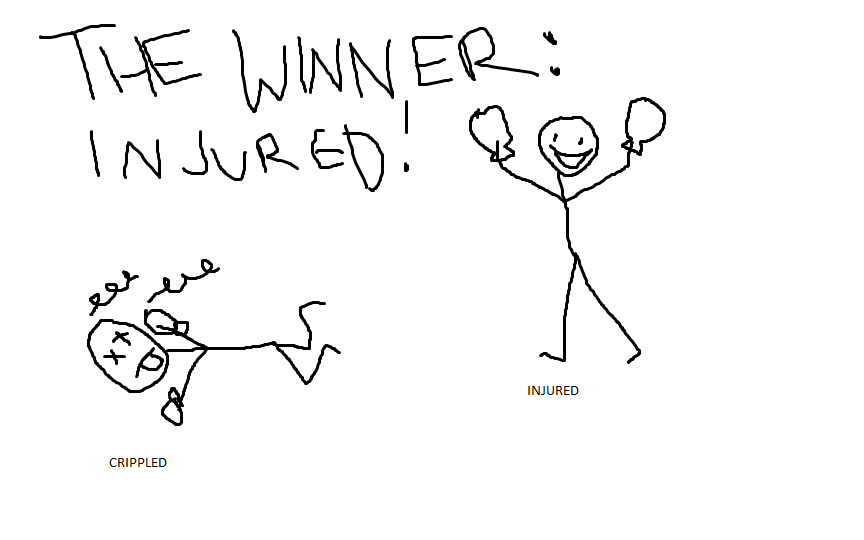
I know it looks like they're both carrying giant hams. Those are supposed to be boxing gloves.

I know it looks like they’re both carrying giant ham hocks… Those are supposed to be boxing gloves. PROUDLY COPYRIGHTED BY J.W. KAIN.

Our thoughts have so much power. If we outwardly do physical therapy and all the stretches we’re assigned by doctors, it won’t amount to much if inwardly we are constantly putting ourselves down. I’m not saying if you think you’re an astronaut that you’ll find yourself floating around in space just because of the power of positivity. What I am saying is if you think you’re a cripple, your body will likely take that suggestion and run with it.

Tune in next week for another edition of WORD WAR WON!

Small Hurt Versus Big Hurt

I am typing this with nine fingers because I lost a fight with a stick blender today. Why is it that small injuries seem to hurt worse than large ones? I sliced my left index finger in a way that (probably) does not necessitate stitches. I had to take pain killers and vodka — not at the same time — and ice it. It’s still throbbing.

… Thrrrrrrooooooobbbbbbbing.

Immediate pain seems to envelop the mind in a way that chronic pain can’t, since chronic pain is something that one comes to live with and therefore ignores. You adjust as necessary. Your back and neck hurt on a daily basis? Change the way you sit so that you don’t aggravate it. Don’t do too much, keep an eye on it, don’t move your head too quickly, and don’t go pole-vaulting.

"Johnson, I just don't think a Jewett back brace and the Olympics are a good match." (Courtesy photo.)

“Johnson, I just don’t think a cervical fusion and the Olympics are a good match.” (Courtesy photo.)

You cut your finger? DISTRACTION NEEDED. OH MY GOD. OH MY GOD, THIS HURTS.

"This is my life now." (Courtesy photo.)

“I guess this is my life now.” (Courtesy photo.)

On the plus side, this is distracting me from my normal pain! So I’ve got that going for me, which is nice.

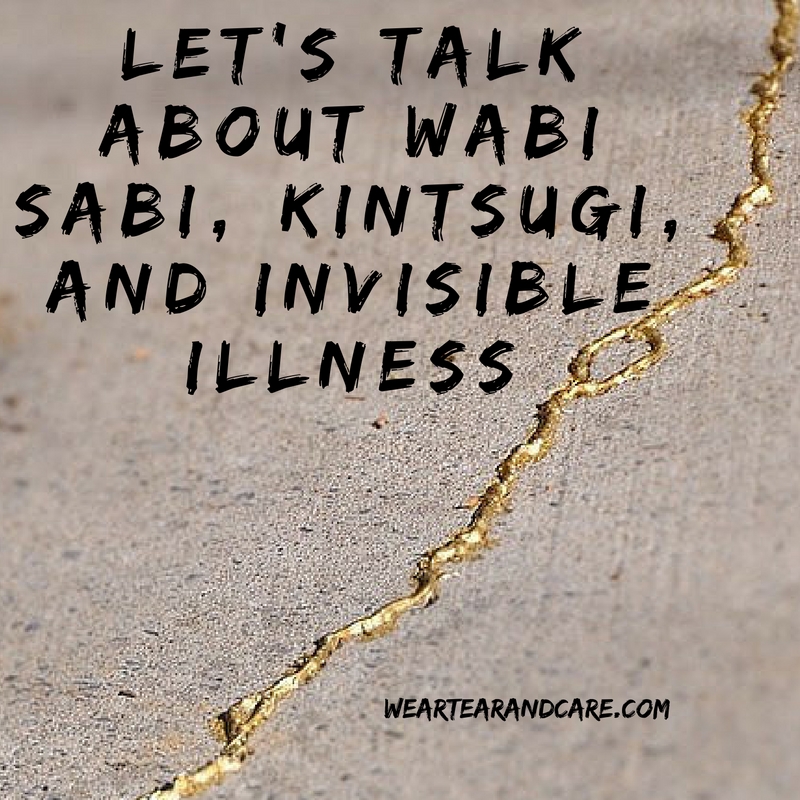
Let’s Talk About Wabi Sabi, Kintsugi, and Invisible Illness

Copy of Copy of Copy of Copy of Copy of I Forgot How To Feel Better

I finally caught up with a couple fragments of thought for this edition of Wear, Tear, & Care. For weeks now I’ve been pondering two Japanese concepts: Wabi-Sabi and Kintsugi.

Wabi-Sabi: “the Japanese art of finding beauty in imperfection“.

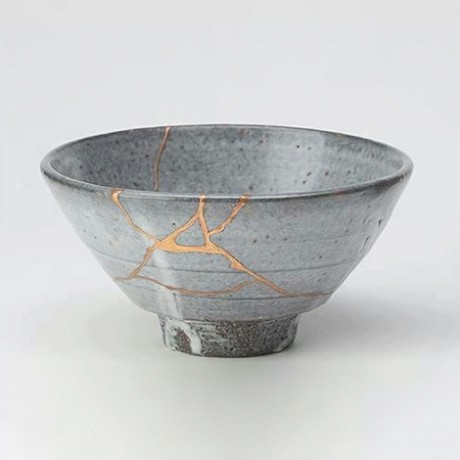
Kintsugi: the art of repairing broken pottery with gold.

These two Japanese practices can easily parallel the difficulties that arise when discussing self-acceptance of invisible illness. More often than not, I find myself saying that because I am not perfect — because I am not a fully-functioning human being, much less a movie-star-like specimen — that I am not worthy or deserving of… what, love? Life? Half the time I don’t even know. The most constant sense I have is that if I am a less-than-able person, then I am undeserving of happiness. That I won’t be happy unless I am whole.

Then I started really thinking about these Japanese practices. With Wabi-Sabi, in terms of how something imperfect can still be beautiful — this is something that I feel like every child is taught in grade school. Even though we’re all different, we are lovely in our own way, etc., repeat ad nauseam.

"Good job there, Jimmy! Keep making... uh... whatever it is you're making." (Wikimedia Commons.)

“Good job there, Jimmy! Keep making… uh… whatever that is.” (Wikimedia Commons.)

It’s the idea of Kintsugi that really gives me pause. It means that something broken can be repaired, and that it then becomes more. It becomes far more than it was originally. It becomes stronger. It becomes shinier. It becomes more magnificent because it has been broken

Let's get crack-a-lackin! (Wikimedia Commons.)

Let’s get crack-a-lackin! (Wikimedia Commons.)

It’s not so much about beauty for me as it is about being whole. Since I’ve been broken not once but twice, I know that I can’t realistically be repaired to 100 percent. I constantly feel like I’m not good enough. Those broken pottery shards might not have been good enough, either. They could have been discarded. They could have been tossed aside because they were no longer useful. But those artists fused the pottery back together with exquisite materials — gold and silver — creating splendid works of art that took the original product far beyond what it had initially been.

I am more than the sum of my parts. I have been experimenting with mindfulness and envisioning what I want for myself; in between all those little fractures and nerve channels in my warped body, I will spin myself with gold, inject the cracks with silver, and become stronger than I was before. The gold will become part of my skeleton, creating a work of art from broken pieces.

Debbie Downer Gets Some Puppy Uppers

The title of this post shouldn’t suggest that I’m on (additional) antidepressants. As much as I love me some puppy uppers, I had a bit of an epiphany this past week at my most recent session with Alexis, my shrink/nutritionist.

First of all, the word “chronic,” as in “chronic pain.” Alexis has yelled at me for using the word “crippled” instead of “injured.” I’m having the same issue now with “chronic.” Chronic is a synonym for stagnant, continuous, endless. That word needs to be deleted from my lexicon.

Memorizing and subsequently forgetting words is how I spend my Saturday nights. (Courtesy photo)

Memorizing and subsequently forgetting words is how I spend my Saturday nights. (Courtesy photo)

Even if this healing process does seem stagnant, continuous, and endless, it is moving forward because my body is constantly changing. I gain weight, lose weight, get a gray hair (ohmyGodthatfinallyhappenedlastweek), pull the gray hair out, get a bruise, lose a bruise. My body is not in stasis. It is changing. I am changing. I will continue to change.

Secondly, my pain has affected the way I react to the world and how the world reacts to me. I hide inside of it because I’m afraid to go outside half the time. I fear being jostled in crowds, tripping on ice, falling to the ground, injuring myself further by interacting with a physical earth that has things in it that can hurt me.

Then I think, “Why should I go to this [party on a Friday night/walk in the woods/birthday party/trip to the Cape/jaunt to the moon] when I won’t be able to sit comfortably and will inevitably have to bag halfway through and flake out?”

As I said in a previous post, I am inherently negative.

"Not only am I depressed, but I've transformed into a middle-aged man." (Courtesy photo)

“Not only am I depressed, but I’ve also transformed into a middle-aged man.” (Courtesy photo)

Why should I always be negative? Why shouldn’t I try to go out with my friends, go on a walk, go to a party? Instead of preemptively psyching myself out, why can’t I just suck it up and participate in fun times?

Except why should I have to “suck it up” at all? Why can’t I change my frame of mind — my approach to life — and accept that I have pain, that it causes certain limitations, and that I am going to do as much as I can regardless? Positivity has been proven time and time again to have an effect on chronic pain. These people do it. So do these people.

I want to change my automatic reactions. Instead of the following transaction:

Random Person: “Hey, we were thinking of going out for drinks tonight. You should come with!”

Hmmm, I think. It’s 4 pm. I’d already planned my day out. I have just enough energy to get home, flop into my recliner, and turn on my heating pad. But I also haven’t seen these friends in a while. I’ve been a crappy friend.

Now, this conversation can take one of two roads. Here is my automatic reaction:

Me: “Aww, shucks. I’d really like to go out, but I’m feeling super terrible today. Rain check?”

PAUSE.

Instead of testing the water, I’d refused to even get near the edge.

"Nope. Looks awful. I'm just gonna sit out here and read." (Courtesy photo.)

“Nope. Looks awful. I’m just gonna sit out here and read.” (Courtesy photo)

I immediately assumed that if I went out with friends that I would be the Debbie Downer of the group, that I would sit in an uncomfortable chair, that the chair would cause me pain, and that I would make everyone else feel awkward when I inevitably had to leave early.

Inevitably? I do not know what’s inevitable. Maybe I’d feel okay if I went out. Maybe I’d even stay up late for once in my life. Maybe I wouldn’t need the entire weekend to recover.

So here’s what I would like the exchange to be:

Random Person: “Hey there! We’re going to a rad place that serves alcohol, you should come with!”

Me: “Vodka with friends sounds nice. What’s the plan?”

That’s what I want. End of story.

The Inconvenient Youth: On Being Young and Chronically Ill

PREACH IT.

marycarolinegolightly's avatarmary caroline

Getting sick when you’re young is unexpected. It certainly came as a surprise to me. But I got used to it, I had to. It’s been years so I’ve adjusted.

The rest of the world, I realize, is not prepared for a young sick person.

Using a cane made my so-called “invisible illnesses” visible, and this changed everything. It’s still one of the best decisions I’ve ever made. So many things became accessible again all because of a mobility aid. But there are always pros and cons, and using a mobility aid is no exception to this rule.

It didn’t take me long to get used to people staring.  My first summer using a cane my aunt Sharon asked, “Is this really what people are like?” and I hadn’t even noticed that day. To me it didn’t seem that bad.

After all, staring is a small offense on the spectrum of daily…

View original post 697 more words